

If Democrats win in 2028—either the left or right factions—they will be handed a bleak future. Right now, America is losing wars on both the trade and military fronts; by 2029, the earliest a Democratic President can take office, the future may be even bleaker. Countering Trump’s policies would be the first, most simple policy to take, but opposition to the status quo is not enough to win an election, and more importantly, to actually governing.
A victory in 2028 need not portend a 2030 midterm defeat, nor a tough, nail-biting re-election in 2032. Democrats can make substantial, transformative policy choices beginning in 2029 that can deliver them an electoral majoritarian constituency that can both keep them in power and deliver for the American people.
We can, in short, have our cake and eat it too.
The Goals of National Development
There are two main goals in creating a national development strategy. The first is rather obvious: to improve the country (its people and constituent components) material conditions versus the present status quo. If we are doing X, a national development strategy would be content with doing more X, so long is there is a material benefit to the American people. This is more important than any cultural or social goal an administration may have—on this metric alone are they judged by the electorate.
The second goal contours the first, and gives it form and meaning: parity. More X, yes, but how much more? This is answered by parity, the notional thesis that America, as a great power, ought to retain some level parity with the next closest great power. On a very practical level, this means that the United States, about as rich and as large as China (if less populated) ought to be able to produce goods on par with China.
Of course, this runs totally counter to the neoliberalizing ideology that has run Washington since the 1980s, wherein manufacturing capacity was offshored to countries with cheaper labor markets to increase profits, China being the forefront beneficiary of this. While it did work in making American stock portfolios blossom and balloon, it also devastated America’s ability to build infrastructure and goods at anything approaching scale.
When a company offshores, it’s not just the factory edifice that leaves, but it’s the entire institution: the workers, their knowledge, the education system that outputs trained workers, the communities that prop up around industrial towns, the know-how of complex machine tools that make manufacturing at scale possible, and so on. If we were to start reshoring corporations, it would take years for the United States to output what we used to output domestically only fifty years ago, and it would take decades for the United States to reach anything approaching parity.
Yet, parity is a worthwhile goal, for the alternative is a frightening one. As the United States begins to lose its role as a global reserve currency and clearinghouse with the rise of China, what does the United States have left? All of our advanced military goods take way too much time to build and are way too reliant on Chinese rare earths to ever be useful in a military context. Even in peace, what do we have? Our manufacturing sector is moribund, our population is aging and shrinking in size; the only growth sector in our economy outside technology is elder care.
If all the Democrats do with the 4 years they’ll have from 2028 is transform America into a more efficient nursing home, they will have deserved their loss in 2032.
So the goal for national development is twofold: improve America’s material conditions while building the capacity to reach parity with China across every comparable and available metric. The former will give the latter the breathing room it needs to succeed (if Democrats lose in 2032, this plan becomes far more difficult and perhaps even irrelevant, for Republicans will just continue destroying this country), while the latter gives the former the dimensions and context it needs to function.
Targets
Electrical capacity
Electrical capacity is the limiting factor for all other modern development, sitting upstream of everything. We cannot build new steel mills, semiconductor fabs, data centers, electrified transport, and the like, without more electrical capacity. No amount of tax cuts or breaks can magic new charged electrons out of thin air, in other words. To say nothing of domestic civilian consumer costs: if Democrats don’t meaningfully lower everyone’s energy bills starting in 2029, they can go ahead and surrender the country in perpetuity to the Republicans.
Status Quo: The US has around 1300 GW (gigawatts) of capacity, compared with the PRC’s 4040 GW. The US adds 50 GW per year while the PRC adds 400 GW.
Target: Increase capacity by 600 GW over 5 years (2029-2034), reaching a total of 1900 GW by 2034. By 2031, we should be adding at minimum 120 GW annually to our capacity. At minimum, we are looking installing at least at several thousand circuit miles of new high-voltage transmission.
This is an absolute floor, not a ceiling to production. It will still leave us with under a third of China’s overall projected capacity, yet also be three times the current amount we are adding.
Semiconductors
A modern economy needs semiconductors like humans need water. It’s not just AI image generation that semiconductors render possible, but everything: all of our phones, our computers, our cars; every single technological thing that exists in the real world presently contains a little microchip made via semiconducting.
Status Quo: The US produces 10% of leading-edge chips, and is firmly reliant on complex ROC (Taiwanese) supply chains right next to the potentially hostile PRC. Even if PRC missiles don’t rain down on ROC fabs, we will still be reliant on a very distant and disparate global supply chain. Considering that semiconductors are also critical for national defense (we wouldn’t want to say, have our ICBMs not work anymore due to a lack of semiconductors), a clear ramp up in domestic production is needed.
Target: Double US leading-edge production to 20%, advanced packaging to 25%, and mature node capacity sufficient for domestic automotive and defense demand, all within 5 years.
Missile Munitions
When talking about state-to-state great power parity, missile munitions cannot be ignored.
First though, it should be noted that while being anti-war, pro-peace is a domestic virtue, and while we ought never to be an aggressor or conqueror, all the wisest in history agree, from Sun Tzu to Vegetius, and beyond: that in times of peace, prepare for war. Obviously, a strong defense deters attack; in nature, a bear is less likely to charge a man yelling and beating his chest than a meek man who hangs his head towards the bear’s maw. But more crucially for a modern context: it’s also great for domestic economic stimulus; the arms industry employs a lot of people, which in turn makes us all richer, which turns employs even more people. Much like horse archers in the pre-modern era, military Keynesianism is a thing that just works. It worked for America in World War 2, it’s been working for Putin’s Russia and Xi’s China, and it can work for us again.
The ideal future, it should be said, is that the US vastly, vastly expands its munitions and ends up in zero wars, committing zero casualties. To build the world’s largest, most powerful armada and keep it maintained as such without ever using it excepting in national defense: that must be the goal of every US politician; if this target becomes a tool for warmaking, our plowshares beaten into swords to slaughter the innocent—then I pray the future generations have the courage to turn their swords against those politicians.
For munitions, specific focus is given only to missiles, not missile defense. Employing a tit-for-tat missile defense strategy is materially infeasible, until ‘sci-fi lasers’ AKA direct energy beam anti-missile weaponry becomes actually usable at scale, and there’s no guarantee that will ever happen. It is thus cheaper and better for ships and bases to absorb hits rather than focus on shooting everything down, which with advanced missiles, is highly difficult anyways. This entails a change in military doctrine: accept losses while overwhelming the foe with firepower, from matching enemy missile production with missile defense production to overcoming enemy missiles with a mass production edge; to win a missile war, build more missiles. This was the same logic used in WW2 for ships, tanks, and airframes; to beat the Nazis and Japanese, we just pumped out far greater quantities of offensive technology than our enemies could compete with. Quantity alongside sufficient quality, especially for unmanned missiles, should be the target.
Status Quo: The PRC produces roughly 1200 high-end missiles per year. The United States currently produces 600-800 high-end missiles per year.
Target: Reach a 2:1 annual missile production ratio with the PRC. This means the United States would need to produce 2400 high-end missiles per year within five years.
Naval construction

Similar for missiles, the United States is laggard when it comes to ship production to the PRC. Using the United Kingdom’s Naval Defence Act of 1889 as a framework, the goal here to create a benchmark for production; that is, the United States should produce 1.5:1 hulls per year that the PRC produces. For instance, for every destroyer China makes per year, the United States should make 1.5 destroyers.
We are using hulls rather than tonnage (the traditional metric) because in modern naval warfare, more ships equals more missiles; a heavier ship just means a ship that takes longer to build and more to maintain. The goal is also set at yearly production, not underlying overall count because the goal is, even in the event of a Pearl Harbor-esque disaster, for the United States to quickly bounce back and out-produce its adversary. It should also be noted that these are only peacetime numbers; in wartime, the ratio should be even higher.
Status Quo: The PRC produces 3.5 destroyers per year and 2.5 attack submarines per year. The United States produces 2 destroyers per year and 1.2 attack submarines per year.
Target: 5-6 destroyers per year and 4 attack submarines per year within 5 years.1
Defense industrial capacity
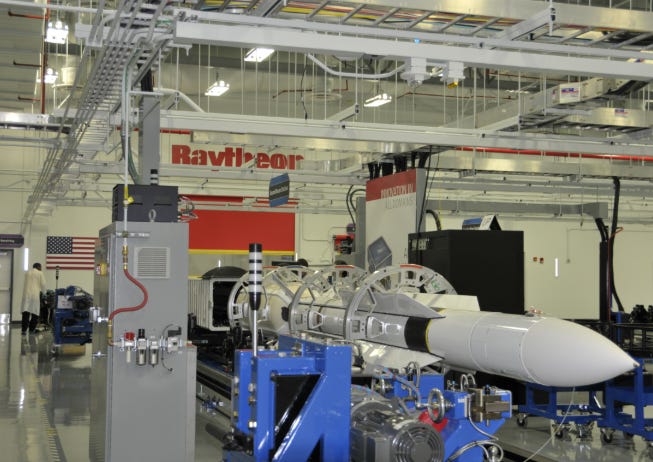
It will be impossible to build munitions without building out defense industrial capacity. This entails building new rocket motor plants, new missile assembly facilities, as well as increased rare earth output, missile seekers, and feedstock. Gallium arsenide and gallium nitride are key, and gallium is among the minerals the PRC restricted in 2023. Ammonium perchlorate also has a supply chain constraint, with just a single major domestic producer. We’ll also need new naval surface combat yards to build out the destroyers, and a net new nuclear submarine reactor facility.
Status Quo: 12% global rare earth mineral output, near zero refinement. 2 naval yards produce 2 destroyers per year, with 2 naval submarine yards producing 1.2 submarines per year.
Target: With domestic and allied mines, produce 70% of demand for lithium, cobalt, graphite, and other rare earths; rare earth separation capacity at least 40,000 tonnes. For naval production, each existing yard is expanded, with 2 net new destroyer yards and 1 net new nuclear submarine yard.
Economic impact: Will cost the US government roughly $65 billion per year and net around 200,000 new jobs. Current costs for shipbuilding sit at $40 billion per year.
Housing

Housing is the largest single line item in the median household budget and the principal explanation for why American living standards have lagged behind American incomes for a generation. No American administration can succeed without addressing the rising cost of housing. Further, without building out more housing, this whole project of national industrial development is rendered moot; no point in building anything, from fabs to missiles, if there are no affordable homes for workers anywhere.
Status Quo: The PRC produces 6~7 million urban units per year (2019 figures)2, now falling sharply. The US produces 1.4 million per year, with 3% being factory-built.
Target: Produce 2.6 million units per year by 2034, with 25% being factory built.
Special note on how: These two below are non-negotiable.
Federal preemption of exclusionary zoning near jobs and transit — by-right multifamily construction, overriding the local veto (the property-rights-compatible version, since it restores an owner’s right to build rather than restricting it).
A national building code to replace the thousands of local ones, which is the specific barrier that has prevented factory-built housing from scaling.
Rail

American freight rail is the most efficient in the world by ton-mile yet runs almost entirely on diesel. Electrifying the trunk lines removes a huge chunk of carbon emissions, lowers operating costs permanently, and insulates the logistics backbone from fuel-price shocks. It is the highest-return decarbonization investment available in transport and is currently unfunded.
At the same time, consumer high speed rail is clearly must from a modernization aspect. Europe and Japan have had high speed rails for decades; we are now two decades behind the PRC on HSR construction.
Status Quo: The PRC has 48,000km of HSR operational. The US only has 735km, and mostly only in the Acela Corridor, and that is only partly high-speed.
Target: Within 5 years, 2 new corridors are opened: California and the Texas Triangle, with the third (Acela) expanded to encompass the fuller Northeast. For freight, we target 15,000 route-miles of trunk lines being electrified (~10% of total freight).
Healthcare
With an aging, shrinking population and incompetent management to boot, healthcare is one of the great cost diseases most American households will face at one point or another. Here we look not to China for parity but to Europe, which unlike China possesses a robust social safety net for healthcare.
Status Quo: The US spends 17.5% of its GDP on healthcare compared to 10-12% of comparable nations in Europe (each of whom live longer lives).
Target: Reduce national healthcare expenditure to 13-14% of GDP, while increasing both the standard and longevity of living; to live longer, healthier lives cheaper is the end-goal.
A special note on how: The true mechanism that makes this possible will not necessarily be Medicare for All or a single payer system. Ultimately, who pays is the same regardless of system; in Medicare for All, it is the taxpayer who is (presumably) progressively taxed to provide this government good. In the current system, it is combination of employer and employee who pay; ultimately, the payer is the American consumer, always. What will enable this policy, truly, will be rate-setting. This entails a total bureaucratic overhaul of private insurance, with the government directly setting rates for care and drugs for domestic consumers. Not only will this end surprise/balance billing, mandate site-neutral payment, but it can also mandate through governmental fiat the lowering of healthcare costs.
Of course, we could go further, to a single payer system, but the transition from 150 million being on employer-provided insurance to that insurance being automatically guaranteed by the government will have to be seamless, and it will take much time to set up, and run into political risks when delays and issues inevitably happen. Rate-setting reform is something that can be enacted immediately.
Batteries, robots, steel, and more

What else should we build? Much more and many things! A robust modern industrial economy must be able to build things, even if those things are not necessarily giving us the highest profit margins, for many of these things are dual use and thus critical in national security. Offshoring machine tool plants to China to save a cheap buck in the 1980s is all well and good, but now that we need to step up naval production to reach parity production with them, it’s far less good.
Status quo:
Batteries: 200 GWh/year, mostly imported (vs 2,500 GWh/year for PRC)
Robotics: 285 per 10,000 workers (vs 470 per 10,000 for PRC)
Machine tools: Net importer, small share of global production (vs world’s largest producer for PRC; produces a third of global output)
Pharmaceutical API: Import-dependent; most generic APIs sourced abroad (vs dominant global supplier of generic APIs and precursors for PRC)
Steel: ~80 million tonnes/year produced mainly via coal-blast (vs 1 billion tonnes/year for PRC at 54% of world output)
Target (by 2034):
Batteries: 1500 GWh/year, domestically produced
Robotics: 700 per 10,000 workers
Machine tools: Triple output
Pharmaceutical API: 60% of domestic consumption
Steel: Retain tonnage output (sufficient for domestic demand) but replace 40% of coal-fired plants into more efficient electric arc furnaces or hydrogen dri.
Households
All the above policies, and policies to be, should be judged on a consumer household level: are they making American lives materially better? This doesn’t mean costs should be lower per se (which would indicate a deflationary process AKA an economic recession), but rather more directly than American incomes should be higher. We can anchor this improvement in material conditions most directly via two metrics, rising median household incomes and life expectancy.
Status quo: Median household incomes have been stuck at around $83,000 per year, while life expectancy is around 79.0 years. Combined household spending on healthcare, housing, childcare, and education equates to roughly 55% of median income.
Target (by 2034): Median household incomes increasing annually by 2.5%. Life expectancy increased to 80.5 years. Combined household spending on healthcare, housing, childcare, and education reduced to roughly 42% of median income.
A special note on how: Beyond doing everything mentioned in this plan, which will be a definite macroeconomic boon and get us most of the way there, the following specific policies will be needed:
Sectoral bargaining: wage and standards floors set industry-wide rather than firm-by-firm, so that raising pay doesn't put any single employer at a competitive disadvantage. This is the European mechanism (and the one thing the PRC lacks) that decouples wage growth from the union-versus-employer fight, and it's the highest-leverage single policy for median wages because it lifts the whole distribution's floor at once. More than Taft-Hartley reform, more than mass-unionization, this alone will do much to uplift every American’s income.
Full employment as explicit macroeconomic policy: the Fed has in recent years been pushing for full employment, as has our fiscal policy. We should make it explicit and aim for full employment, always. Everyone who wants a job and can work a job should be able to get a job.
Immigration reform: The US is currently below population replacement levels. Without a substantive increase in new migrants, we risk becoming Japan: a massively larger old population dependent on a sliver of the youth to survive. Increasing the labor supply, especially in sectors where demand exceeds supply, is a must.3
Sliding-scale universal childcare as a share of income (standard is 7%).
Expand provider funding for childcare.
Paid family leave, which reduces the years of paid childcare a family needs.
Free community college and public university tuition, or income-contingent repayment that caps payments as a share of income.
Build out infrastructure for vehicle safety and continue lowering overdose deaths.
Lower firearm homicides/suicides via mandatory licensing and medical/mental certification regimes.
Institutions and Instruments
At least seven new Federal bodies must be created or rebuilt, each specified with its authority, its legal basis, and the failure it exists to prevent.
The National Development Commission.
~600 professional staff at 85% of private-sector compensation. This body will have the power to designate priority projects, publish the official National Development Plan, run review, and report annually against every numbered target. Its consequential power is consolidated permitting: designated projects receive a single federal decision on an eighteen-month statutory clock.
Why: because the targets cross a dozen agencies with conflicting mandates and no one accountable for the aggregate. The compensation figure is not a specious perk; an agency that cannot hire transmission engineers cannot plan transmission, which is why federal technical capacity has been progressively outsourced to the contractors it is meant to supervise, which has seen costs balloon and output slow down.
The National Development Bank.
$400 billion in paid-in capital leveraged to a $2 trillion dollar balance sheet, lending at thirty-year tenors into binding-target sectors at Treasury plus a modest spread, with ten-year staggered board terms. Precedent runs through the Reconstruction Finance Corporation, which financed much of American war mobilization, and Ex-Im.
Why: because commercial lenders will not otherwise write thirty-year paper against assets with fifteen-year paybacks and political risk. Losses are expected and budgeted.
By pursuing preferential risk-weighting for lending in binding-target sectors (with Federal first-loss guarantee on qualifying project finance), a transmission or fab loan will consume materially less bank capital than an equivalent commercial real estate loan. Priority lending becomes more profitable per dollar of bank equity, and allocation shifts without a directive being issued.
The Office of Strategic Procurement.
Consolidates multi-year purchase authority across Defense, Energy, and Transportation Departments, issuing ten-year binding offtake for vessels, munitions, transformers, transmission equipment, rolling stock, and processed mineral output.
Why: because annual appropriation is the specific mechanism by which American industrial capacity fails to get built. The federal balance sheet is the most valuable industrial asset in the country, currently deployed twelve months at a time. The OSP will operate on a five-year budgeting cycle; once established, it is meant to be insulated from the winds of political change.
This also ensures demand certainty, with a five-year binding offtake, appropriated in advance. The state should be telling suppliers far enough ahead, with sufficient legal firmness, that they build the capacity to fill all necessary orders.
The Federal Permitting Court.
An Article III court of specialized jurisdiction, 180-day docket, standing limited to parties showing concrete injury. Congress controls lower-court jurisdiction and has channeled review this way before.
Why: because American infrastructure is delayed by litigation risk rather than adverse rulings. Projects die in anticipation of court, not from losing. Congress has direct Constitutional power to direct the Courts to cut it out, in other words, and stop holding up necessary projects.
The Skilled Trades and Engineering Corps.
Apprenticeship expansion, training capacity, and expedited occupational visas in the trades the targets require; jointly under Labor and Homeland Security.
Why: because labor as the binding constraint on every target, and no existing body is responsible for producing four hundred thousand tradespeople. If domestic supply of labor cannot be met, then an international supply will be needed; hence, DHS.
The Reconstruction Zone Administration.
Administers thirty competitively awarded zones. Reports to the Commission.
These thirty zones are awarded competitively to states and metro areas. Winners receive pre-permitted land, delegated permitting with statutory shot-clocks, bank priority, workforce funding, and front-of-queue interconnection; winners commit to output targets, prevailing wage floors, and by-right industrial and residential zoning within the boundary. Performance is published in an annual ranking.
Why: because Federalism is a boon and an asset, and should be fully embraced in a development strategy.
Two legal constraints bind this: conditions attach only to new money and never to existing streams, because NFIB v. Sebelius struck down conditions that coerce a state by threatening funds it already relies on; and zoning preemption must rest on the Commerce Clause directly rather than on funding leverage. Both are defensible, and both will be litigated.
The Strategic Equity Commission.
Federal support above a defined threshold should automatically convert to non-controlling equity, meaning economic participation plus a golden share carrying veto over foreign acquisition, continuity-of-operations obligations, and domestic-production covenants.
Why: because the public assumes the downside and should hold the corresponding upside, and infrastructure the nation depends on should not be transferable to a foreign buyer at one owner’s discretion. Non-controlling is a legal requirement, not a preference; uncompensated controlling stakes raise takings problems under the Fifth Amendment, and provisions aimed at named firms raise bill-of-attainder problems under Article I. The structure must be general, prospective, and tied to benefit received.
Funding
Other than raising income taxes for top earners (a wealth, or a billionaire’s, tax), we could also consider a progressive consumption tax as the spine, with capital income taxed at ordinary rates with realization-based anti-avoidance, a carbon tax with border adjustment, and a land value tax. While we’re fixing the tax code and simplifying it (a progressive consumption tax would allow us to get rid of most of the tax code4), we should also make Social Security made permanently solvent through cap abolition paired with benefit-formula adjustment at the top (12.4% above cap). This gives us a recurring revenue pool of near $4.9 trillion, approximately matching current revenue collections, but one that should have more a positive distributive impact to American households vis a vis the status quo.
It should be noted, of course, that most of everything in here is debt-financed. We are not seeking to balance the budget as an end-all, be-all good. Most economists will agree that pursuing such a goal is both economic as well as political folly. So long as we are raising enough revenues without harming household median incomes, we are doing well.
At the same time, lowering healthcare costs while raising household incomes will make available trillions of new dollars in capital, which is what makes this National Development Plan ultimately affordable, in spite of the high sticker price for some items.
Sequencing
2029-2030
Statutes enacted, commissions staffed, banks capitalized, risk-weighting rules issued, zones designated and awarded, procurement converted to multi-year, domestic transformer manufacturing and solid rocket motor capacity capitalized as first Bank priorities.
Little of scale is built in this window, and this is on purpose: appropriating at scale before the execution machinery exists reproduces the CHIPS experience, in which authorized money sat against a process that could not disburse it, and the wrong lesson was drawn about the money rather than the process. Before a single inch of material is laid down, we need to build the framework that enable all future construction.
2030-2032
Grid and transmission at peak construction. Fabs are now being built. Naval yards are being reconstituted. Munitions lines reaching rate, with housing supply responding as zoning clears. Mid-term review at month thirty, with authority to reallocate up to a third of committed funds; the flexibility annual appropriation provided, retained at a cadence construction can absorb.
2032-2034
Capacity comes online. Targets scored publicly against the published numbers, by the Commission. The second 5-year capital budget (2034-2039) is drafted from the results rather than from ambition.
Constraints
Skilled labor
The binding constraint on every target. The program requires roughly 400,000 additional electricians, welders, pipefitters, and process engineers who do not exist and cannot be produced in under four years. Apprenticeship expansion begins in year one and still arrives late relative to the construction curve. The offsetting instrument is direct recruitment of trained tradespeople and engineers from abroad; the one structural advantage the United States holds that the PRC cannot replicate. China cannot import skilled labor at scale; the United States can, and currently does not. It is the least-used instrument in the American toolkit and the fastest-acting one available.
Transformers, turbines, and rocket motors
Large power transformers carry roughly four-year global lead times, and solid rocket motors are constrained to two suppliers. Both make domestic capacity a year-one banking priority rather than a downstream consequence, because the electricity and munitions targets are otherwise physically unreachable regardless of how much downstream capacity is funded.
Litigation
American projects die from process rather than opposition. The permitting statute is the load-bearing wall of this budget. If it is struck or narrowed, then this whole plan is pointless.
Constitutional exposure
Three provisions carry real risk: the land value tax on apportionment grounds, zone conditions on coercion grounds under NFIB, and the permitting court’s docket limits on due-process grounds. The authorizing legislation should be drafted with severability throughout, so that losing one instrument does not unwind the structure that survives.5
Reversal
The capital budget outlasts the Congress that enacts it, which is the point and the vulnerability. Durability must be engineered: five-year appropriations that create contractual liability enforceable against the government, bank governance insulated by staggered terms, zones distributed widely enough that reversal carries a constituency cost in most states, and a statutory cycle that makes the succeeding budget an obligation. None of this binds a future Congress, which retains full authority to repeal; it raises the real and political cost of doing so.
Execution quality
Capital is abundant in the United States and competent project management is scarce. This is why the Commission pays market rates, why its staffing is a year-one milestone, and why the sequence front-loads institutional construction over disbursement. The Manhattan Project hired the best of the best to win the war, and the National Development Plan operates on similar logic. When it comes to the question of existential national survival, we shouldn’t save pennies on the dollar on key hiring decisions.
Note: All of this will take time to set up. Even if we prioritized the maximal budget we wanted for this task, it will still take time. Munitions reach full rate in four to five years, destroyers in seven to nine, submarines in twelve to fifteen.
Yes, the PRC build too many housing units. We don’t necessarily want parity here; but we should still drive to double our current annual production to meet domestic demand.
This does not mean border abolition or anything like that. If nothing else, from a purely governmental data standpoint, every person who enters the US should be noted down, and if we are doing that, we can also ensure they only enter the US legally and on invitation-only. We don’t need to compromise on border security (which is labor market as well as national security) at all.
Some good reading on a progressive consumption tax:
https://www.princeton.edu/~ceps/workingpapers/93bradford.pdf
https://www.aei.org/research-products/book/progressive-consumption-taxation/
Congress can also opt for One Weird Trick to render these laws above Supreme Court review: adding a line in the legislation that says “this law shall not be subject to judicial review by the appellate courts”, which is something technically in the power of Congress’ authority—though, this is untested and could result in something approaching a minor Constitutional crisis between the Courts and Congress if allowed play out fully. Worth considering, at least.
This is all wonderful and covers most things related to the real-world development that has to occur in America. While it may seem pipe dream-ish, the CWA came to employ 8% of the American workforce in ‘33 within about a month of its founding. So it is possible, if we can find the political will among ourselves, the President, and Congress for it.
My only concern is with one subject I believe you may have inadvertently overlooked while covering just about everything else (although I can forgive it, as you discuss numbers rather well):
What about the American invasion of Greenland?