

Many have said international law is dead. And it may very well be! Let this be its final test; if we cannot save 20,000 sailors from a grim fate, we cannot save anyone.
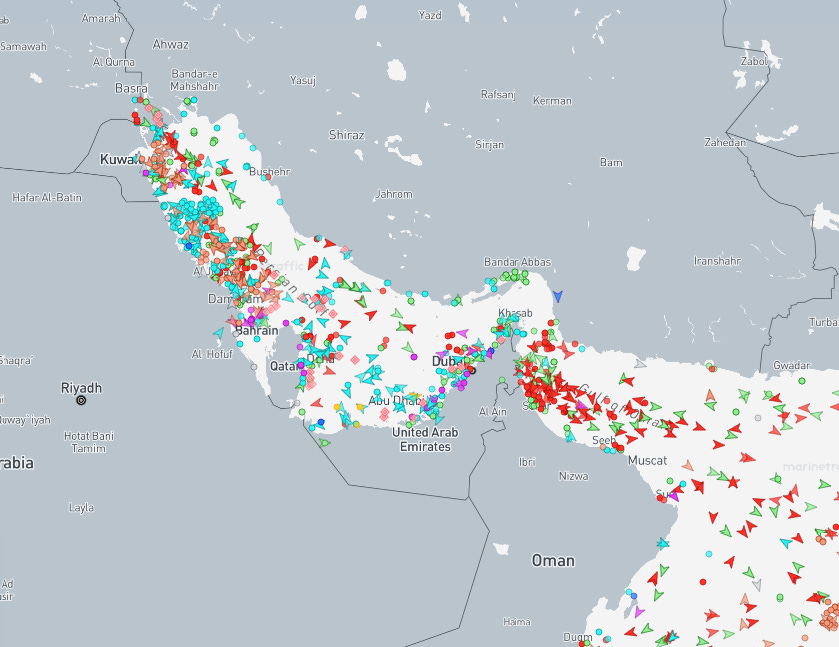
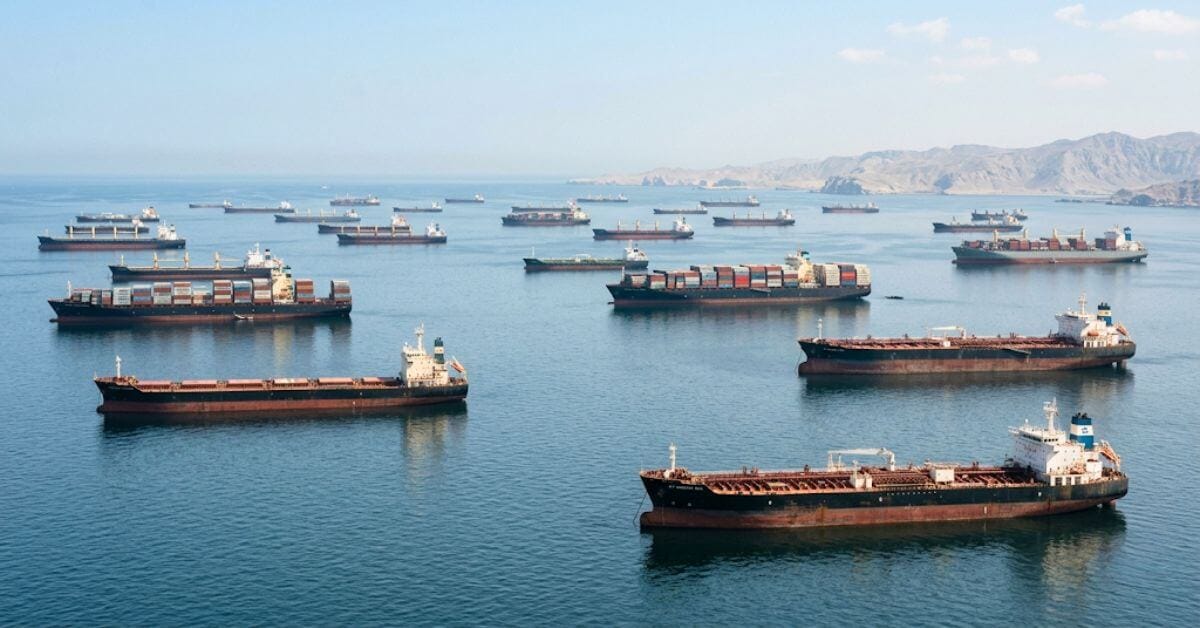
As of today March 20, 2026, more than 3,200 commercial vessels carrying roughly 20,000 crew remain trapped west of the Strait of Hormuz. There are confirmed reports of food and water are running low. Some crews have already endured missile strikes, drone harassment, and GPS jamming, while all the ports in the Persian Gulf are currently refusing them docking access rights.
There is no escape, not while Iran keeps the Straits closed (indefinitely, by all accounts) and while insurance guarantees have ceased. It is possible that some ships will be able to leave soon, via state-to-state national agreements with the warring parties allowing safe exit out of Hormuz but for some other ships, this will come too slow, too late, or never at all. Every additional day risks mass casualties, ranging from dehydration, to heat exhaustion, to starvation, to any other mass epidemic diseases that can become rife in such conditions.
The crews on these vessels are not combatants; they are civilians from India, the Philippines, Greece, and dozens of other nations whose only “crime” was being in the wrong shipping lane at the wrong time. Leaving them to starve or die while diplomats haggle over tanker routes is both immoral and strategically foolish. Dead seafarers will not lower oil prices, will not restore global supply chains, and will not help anyone win the wider conflict.
The International Maritime Organization’s push for a “safe maritime corridor” to evacuate both ships and crews is noble in intent but dangerously impractical in execution. Iran has made clear it will not allow ships with Western (e.g. NATO member states) ownership or flags to transit the strait without concessions. For some ships, such as US-aligned ones, Iran has promised to interdict those vessels, and indeed, it has already struck several. Demanding full ship movement now risks turning this humanitarian crisis into a shooting gallery in the worst case, but most likely: nothing happens at all, and those 20,000 people suffer aboard their ships indefinitely.
There is a faster, lower-risk alternative: immediate, time-limited, personnel-only deconfliction zones. There is both international law and precedent for this.
First, under the Safety of Life at Sea (SOLAS) Convention, every state (Iran, Israel, and the US are all signatories) has an overriding duty to protect seafarers. Iran itself has recently affirmed it has no express desire to harm mariners trapped at sea.
We also have recent precedent that proves this works, even in the worst (in terms of active, deadly hostilities) of circumstances:
The 2022 Black Sea Grain Initiative, which showed that even warring parties can carve out humanitarian lanes when the world demands it and a credible mediator (Turkey and the UN) holds the pen.
In Syria, U.S. and Russian forces maintained deconfliction protocols for years to avoid accidental escalation while saving civilian lives.
The proposal is straightforward and could be operational within days:
Designate between the warring parties two or three fixed “safe boxes” in international waters of the central Persian Gulf, well clear of Iranian territorial seas and minefields. The exact coordinates should be announced and published beforehand.
Set up recurring 48 to 72 hour humanitarian windows every three or four days, giving all parties 48 hours’ advance notice through a neutral coordination cell hosted in a specially-designated demilitarized city for the duration of the evacuation (e.g. Doha or Muscat), or in another neutral venue. During these windows, civilian helicopters and small rescue vessels (operating under IMO, Red Crescent, or flag-state charters) would lift crews off the stranded ships and ferry them to a specially-designated deconflicted port in Qatar, the UAE, Bahrain, Oman, or Saudi Arabia. Further commercial charter flights should be sponsored for those sailors to return to their homes, or to their next ship assignments.
That empty vessels in the Gulf would remain at anchor is what makes this agreement amenable to Iran, who presently holds many of the military cards on the proverbial table. It would also remove any further pretext for further attacks on “hostile” shipping; Iran would only be doing acts of international environment terrorism in that case, as those ships are not usable without crews.
When the war hostilities have ceased, the fate of these ships will be decided then.
Verification would be simple using real-time AIS, commercial satellite feeds, and a dedicated military-to-military hotline to ensure neither side exploits the pause. During these times, no military assets would enter any of the zones, no cargo would be allowed to move, and everyone gets to go home safely.
This is no gift to either side. The only “side” that benefits is our common humanity. For even, and arguably especially, in these states of tragic war, if we lose our humanity, whatever else do we have left? Are we to really burn the “global village” for its sole value in immediate warmth?
Admittedly, the IMO emergency session that just concluded was a good start. Now it must go further.
A Direct Plea
Secretary-General Arsenio Dominguez!
You should immediately table a “Seafarer Humanitarian Evacuation Protocol” built around these deconfliction windows. Oman, Qatar, the UAE, and Bahrain, already co-sponsors of the broader corridor idea, should offer to host the coordination cell and guarantee the safe boxes. The United States can signal quiet support through backchannels; Israel can do the same. Iran has repeatedly said it respects the lives of non-combatant seafarers. Here is its chance to prove it.
Twenty thousand men and women did not sign up to be human shields in someone else’s war. They signed contracts to deliver oil, grain, and goods that keep the world fed and fueled. The least the international community can do is to give them a safe, time-limited path off their ships and onto airplanes home.
The ships can wait. The people cannot. Time-limited deconfliction zones are not a perfect solution. They are the only solution that can start saving lives next week instead of next year. The diplomats have had their chance to posture. Now they must act.