

Everyone looks to the past for inspiration on how to conduct the struggles of the future. This is not a solely unique feature amongst traditional conservatives, who often desire to harken back to the glories of past empires of yore like Rome or Germany, but one held universally, even amongst normally anti-traditional leftists as well. We humans are the sum of our collective experiences; all preexisting knowledge and understanding is built on the foundations of those who came before us.
Right now, there is undoubtedly a young Leftist in America writing a pamphlet, or paper, or essay, or podcast, or whatever, titling/referencing Lenin’s classic polemic What Is To Be Done? What is to be done? A great question, with the implied answer: by copying Lenin’s polemic, we hope to copy not only his analysis, but his victories, his successes. The thinking goes—if only we could do what Lenin did, we would achieve the same successes he did.
And so Leftists not only write their own what-is-to-be-dones, but they call themselves Leninists, uphold and enshrine the words of Lenin, as if by the grace of his ideas and his party alone was the thousand-year Russian Empire overthrown.
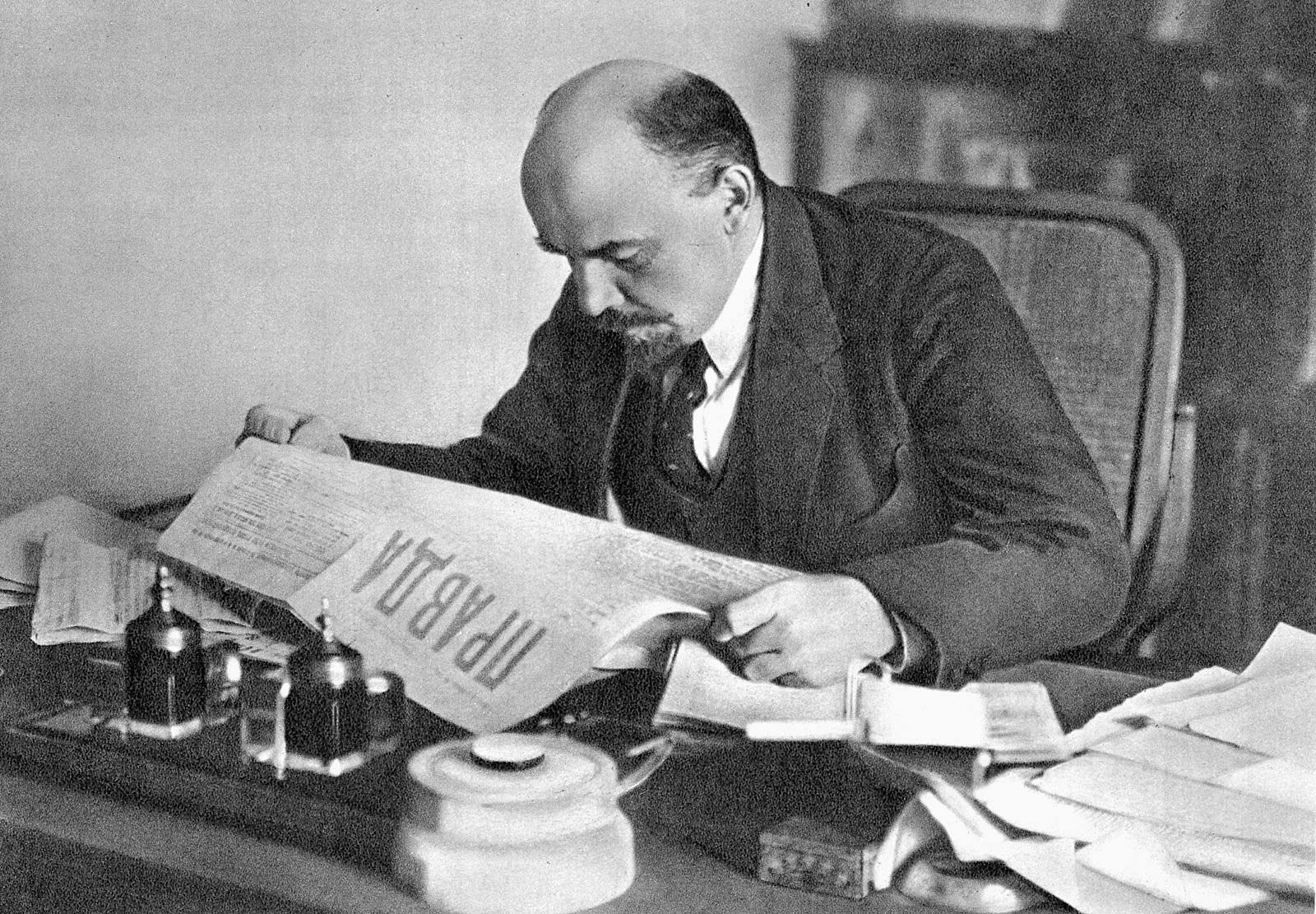
This is an immaterial, ahistorical view, of course. Lenin was history on horseback, as Hegel commented of Napoleon, but material circumstances alone allowed him to achieve that victory.
It was not the correctness of his ideas, his skills at interpersonal debate, or his ability to write polemics that achieved final victory for the soviets and his Party.
How did Lenin win, if we consider all the material conditions? We conclude that Lenin was able to take advantage of being in the right place, at the right time, with the right organizational system. All three are important factors:
If Lenin had not been near and around Petrograd, if he had not been in Russia, he would have missed the revolutionary moment.
If Lenin lived before or after 1917, he would have missed the revolutionary moment.
If Lenin did not help and guide the Bolshevik Party, they would have missed the revolutionary moment.
Of those, only the last was a thing he could control and indeed, it was his main contribution to the revolution. But without being in the specific time and place correct as well, Lenin would have been a footnote in history.
Thus, we must analyze and specify the conditions of the Russian Empire before and during the 1917 Revolutions to understand how and why Lenin and his party, out of all of them, succeeded. Understanding this is critical, for as Leftists grapple with the ever present questions of reform or revolution, of what is to be done, they must be realistic in their assumptions and analysis of their own countries.
And, once we do this for Lenin, we can safely conclude that his specific rise to power, then and there in Russia in 1917, was wholly and solely due to the First World War, and Russia’s collapsing political economy, which left it incapable of dealing with the demands of such a modern, totalizing war.
The Terrible, No-Good, Very Bad War
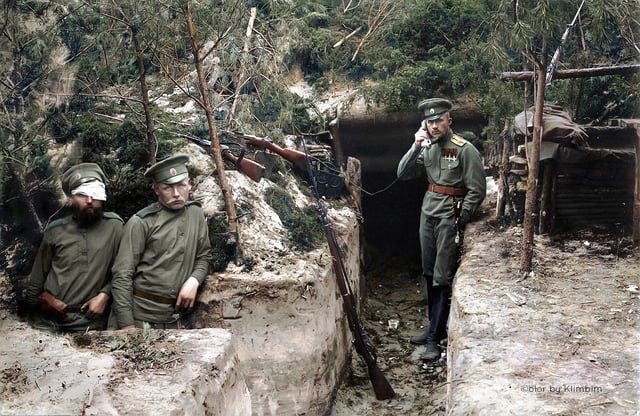
Let’s start with the Russian Imperial Armed Forces, who were to be the primary revolutionary actors during the 1917 Revolutions.
Before World War 1, the Russian state had a population of around ~155 million to 170 million peoples, most of them concentrated in the European part of Russia.
Of those, during the war, Russia mobilized 15 million men. Out of those 15 million, 3.3 million were taken prisoner, 2.25 million died, and another 5 million were wounded. In effect, two-thirds of all Russian soldiers during WW1 either died, got wounded, or spent the war in a prison camp1.

The heavy casualties at the front, regardless of how they were achieved, completely changed the unit make-up of infantry units. Turnover was high; some estimate that infantry unit compositions were changed six times during the war2. This meant that previously loyal regiments, even the vaunted Imperial Guards, were being staffed with new raw recruits. As the war dead and wounded mounted, with no end in sight, and with casualties running extremely high, a breaking point became inevitable.
In December 1916 it came, in the form of the 17th Siberian Regiment refusing to attack during an operation and enticed several other regiments to mutiny alongside it. While this mutiny was put down, it ruptured any remaining trust the average soldier had in their officers, many of whom were already despised.
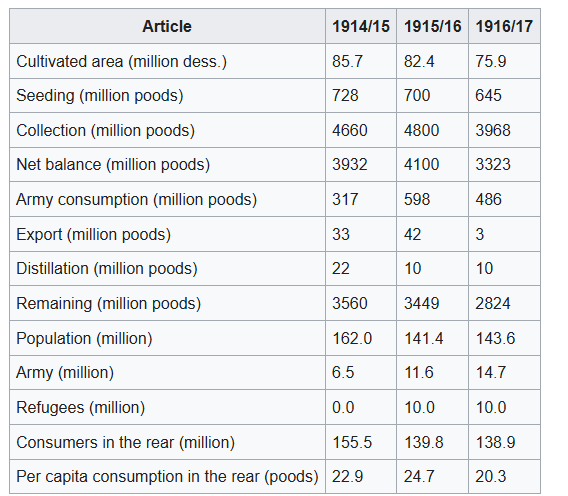
As the military situation disintegrated at the front, the home front fared little better. It is well known that the Tsarist state entered the war incapable of actually fighting a modern, total war. While they were able to avoid rationing food (to say nothing of starvation) at first, the war caused such a strain on state finances that it led to a series of inflationary shocks. At the same time, the military kept drafting men to the front, leading to severe supply shocks needed to keep agricultural and industrial labor supplies intact.
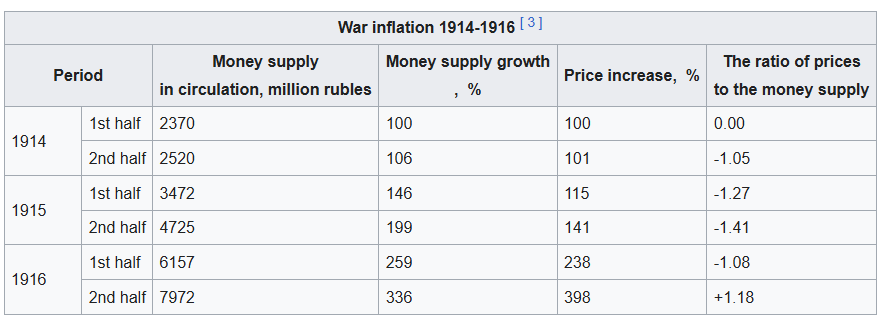
By the end of 1916, fats and sugars were already running out in key parts of the empire, and other areas found it impossible to import food at any price, due to inefficiencies of the transport system. This in turn exacerbated the food crisis, which became acute during the Winter of 1916-1917.
The French ambassador to Petrograd, Maurice Paléologue, commented prior to the February Revolution:
A revolutionary crisis is brewing in Russia; it nearly broke out five weeks ago; it has only been postponed. With each passing day, the Russian people are losing interest in the war more and more, and the anarchist spirit is spreading through all classes, even in the army. Around the end of October, a very telling incident occurred in Petrograd, about which I informed Mr. Briand . A strike broke out on the Vyborg side, and the police were badly mauled by the workers; two infantry regiments, quartered nearby, were called in. These two regiments fired on the police. A Cossack division had to be hastily called in to bring the rebels to their senses. Consequently, in the event of an uprising, one cannot count on the army... My conclusion is that time is no longer on our side, at least in Russia, that we must now foresee the bankruptcy of our ally and draw all the necessary conclusions from this.3
If the people in the rear were suffering, the soldiers at the front were not spared: in October 1916, the army (excluding the Caucasian Front) received 45% less food supplies, in November – 46.3%, in December – 67.1%, in January 1917 – 50.4%, in February – 57.7%. Cold winter led to 5,700 train cars getting stuck, and of the 450 train cars needed to deliver food to Petrograd daily, an average of 116 were delivered in February.4
As the British ambassador to Petrograd to Tsar Nicholas wrote later:
The only issues I brought to his attention were the food crisis and the size of the Russian army. Regarding the former, I told him that, according to my information, food reserves in some provinces were so meager that supplies were expected to cease within two weeks. The reason for this decline in reserves was apparently the lack of coordination between the ministries of agriculture and transport, as well as the absence of an organized distribution system. This latter function, I pointed out, could be successfully entrusted to the zemstvos. The Emperor agreed that the Minister of Agriculture should utilize the services of the zemstvos, adding that if the workers did not receive bread, strikes would undoubtedly break out.
Indeed, strikes did break out, caused by a lack of food being delivered to the cities.
As this was all happening, the central government was thrown into a crisis of their own making: total, crippling indecision at the top during the most critical hours and days of the revolution. This was only made possible as the Tsar had spent most of the war far away from Petrograd, in distant Mogilev. His absence from Petrograd during the uprising allowed events to quickly spiral out of his or anyone’s control. By the time he started to return to Petrograd, striking railroad workers in effect stranded him in the Russian wilderness, far from Petrograd.
In Petrograd 1917, further mobilizations were carried out among the fourth-priority reservists, many of whom were well older, with some older than 40. Their numbers were inflated: some reserve companies had over 1,000 soldiers, and battalions had 12,000-15,000; in total, 160,000 soldiers were squeezed into barracks designed for 20,0005.
These soldiers were to be used in an offensive, which they had little interest in participating in. Many of these soldiers also were exposed to leftist pamphlets and newspapers in the city while they awaited the inevitable, radicalizing them further as leftist parties organized in the garrisons themselves. When the soldiers were ordered out, to shoot their own protesting civilians in February 1917, they mutinied in vast numbers instead.
Conditions were even worse at Kronstadt near Petrograd, where Russian sailors for the Russian Imperial Fleet were quartered.
The very conditions of naval service require people with specialized technical training and create a demand for skilled workers. Every sailor is, first and foremost, a specialist—a miner, a galvanizer, a gunner, a machinist, and so on. Each specialty presupposes specific knowledge and a certain technical training acquired through practical experience. Therefore, the navy primarily recruited workers who had practically completed vocational training and mastered a particular specialty. Mechanics, fitters, machinists, mechanics, and blacksmiths were especially eagerly accepted.
...The Kronstadt sailors were almost entirely former city workers.6
In September 1917, the Chief of the Black Sea Fleet Robert Nikolaevich Viren wrote:
One push from Petrograd would be enough, and Kronstadt, along with the ships currently in the Kronstadt port, would rise up against me, the officers, the government, whoever you like. The fortress is a veritable powder magazine, with the fuse burning low—in a minute there will be an explosion… We try, exile, shoot those found guilty, but it doesn’t achieve its goal. You can’t bring 80,000 to justice. Yesterday I visited the cruiser Diana, and the crew responded to my greeting in a formal manner, with poorly concealed hostility. I peered into the sailors’ faces, spoke to some in a fatherly manner; either this was the delirium of an old sea dog’s weary nerves, or I was present on an enemy cruiser—that’s the impression that nightmarish inspection left on me. In the wardroom, the officers openly said that the sailors were all revolutionaries.7
By February 26, 1917, as more workers and city residents protested the lack of adequate food supplies and food inflation, the Volyn Life Guards Regiment, specifically, the supposedly most loyal part of the Regiment, the so-called “training teams” were deployed to confront the protestors. They shot them in the streets, killing up to 40.
The next day, the Staff Captain in charge, Lashkevich ordered another group of protestors shot. But the soldiers had had enough. They executed Staff Captain Lashkevich instead, and then the entire Volyn Life Guards Regiment went over to the protestors’ side. This didn’t start with just any regular old army regiment but the most loyal parts of it, the specifically-trained-to-butcher-civilians “training teams”. Not only that, these were supposed to be the cream of the crop—the Life Guards were the most loyal units in the entire Russian Army, in charge with protecting the Tsar’s regime and life. And, in the end, they all chose rebellion over mass murder.
This in turn broke down morale throughout the rest of the Petrograd garrison, and then to the rest of Russian Army; in effect, overnight, the Tsar and his government had lost control of the ability to order their soldiers around anymore. To use an American analogy, it would be as if the President ordered Delta Force to gun down protestors, only to see Delta Force join the protests themselves.
As stated prior, when the Tsar attempted to return to Petrograd, striking railroad workers stranded his train, and with no available loyal military units anywhere close to him or the major cities of Russia, he abdicated.

The rest, as they say, is history, albeit, important history. It’s important to pause here, however, to reflect on what just happened. Already in February 1917, material conditions in Russia had induced the following:
The beginnings of famine conditions
A military invasion by a hostile foreign power
A demoralized and under-equipped army left to cope
The collapse of central political authority
When thinking on the question of ‘what is to be done’, it is equally important to ask ‘what has been done’, i.e. what are the present material conditions in your specific country.
Is your country suffering from food privation—not just the otherwise ‘normally’ indigent in a capitalist society but even the well-off and well-to-do, the shop merchants, shopkeepers, doctors, lawyers, and civil servants of the world—is hunger happening at a mass scale, trending towards famine?
Is a military power invading your territory, capturing and holding towns, imposing their own rules and laws on your sovereign land?
Is your army totally demoralized? Would they rather surrender or mutiny rather than accept an order to march to the front, or to shoot protestors?
Has central political authority collapsed, such that the answer of “who runs the country” depends not just on when you ask it, but who you ask.
In Russia in early 1917, the answer to all the above questions was yes. When Lenin descended the train in Petrograd in April 1917, he entered a political cacophony, with all the old systems of repression smashed, and the new ones incapable of much independent action.
As soon as the Tsar was gone, a new self-appointed civilian government composed of the old Duma arose to rule the state in his stead. At the same time, the workers, peasants, and soldiers, spurred on by the radical parties in the city, including but not solely Lenin’s, organized their own self-governing communes (aka ‘soviets’).
Throughout the rest of 1917, the Russian Empire slowly and then rapidly disintegrated. With dual powers competing for total state control, complete with competing priorities, the deteriorating economic and military situation got worse for Russia. The civilian Duma-appointed government, inheriting the Tsar’s war against Germany, found itself incapable of dealing with the German advance and the collapsing economy. Over the summer of 1917, the civilian government attempted an offensive, which due to the collapse of morale (the situation had only gotten worse, with soldiers now appointing their own officers), led to massive reversals at the front, with Petrograd itself threatened by advancing German armies.
If there was a moment where Lenin fully ascended and became history on horseback, it was here. The Bolshevik Party, having been consistent since the war’s start on the need for immediate peace without annexations, found all the recruits it would need in the barracks and garrisons across the major cities and centers of Russia. In effect, the Bolsheviks promised an immediate end to the war with Germany, which was exactly what all the soldiers wanted to hear. No draftee, be he peasant or worker alike from some small village or city, wanted to march off to die, be captured, or be wounded by the Germans—which was by far the likeliest outcome by late 1917 for all of them.
For the civilian population, the Bolsheviks promised to fix the food distribution system and to improve working conditions for workers, which earned the loyalty of the workers in the cities. For the peasants, who had spent much of 1917 overthrowing landlords, cancelling debts, and taking over their own land, the Bolsheviks promised to legally uphold the already in-effect peasant land seizures, earning the peasant’s loyalty as well (the civilian provisional government only promised that the future Constituent Assembly would one day consider the Land question; in effect, threatening the return of the landlords and undoing the land reform).
When the soviets had new elections in the fall of 1917, the Bolsheviks found themselves with a majority for the first time. In command of one of the powers of the state, they immediately organized to overthrow the other competing center, the Duma-appointed provisional government, which they were able to accomplish relatively quickly in October-December of 1917.
They were able to do so, of course, because they had chosen to champion incredibly popular policies with the classes that supported their revolution, which in turn was broadly supported by most people.
When the October Revolution happened therefore, in major cities across Russia, all the various garrison units, which were vastly more loyal to the soviets than to the provisional government, simply left their barracks when ordered to by the various soviets, put whomever the provisional government had in charge under arrest (if they could get to them), and then handed authority over to the soviets. Thus much of European Russia was overtaken by the Bolsheviks in a few weeks; while some cities like Kyiv and Moscow resisted somewhat, most (like Petrograd), fell without much of a fuss.
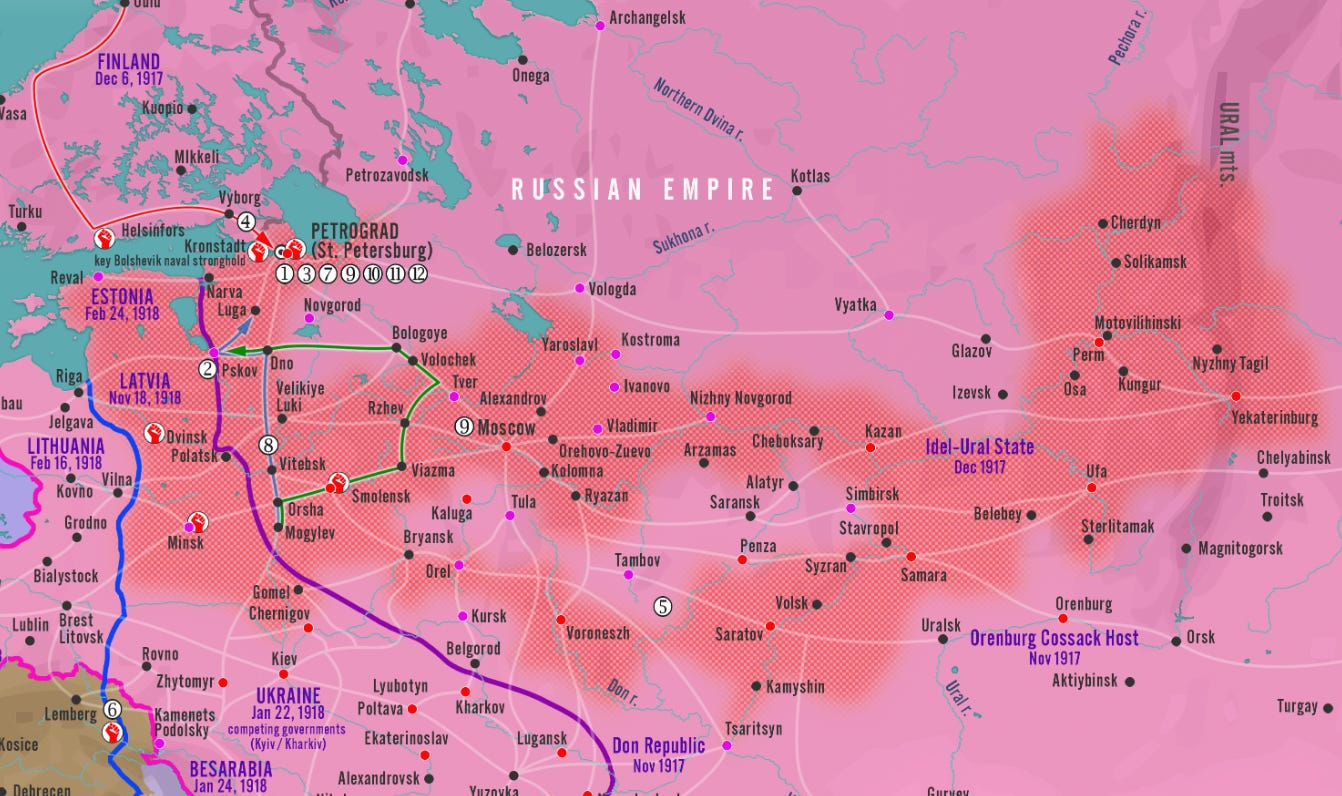
And, really, by then, the rest was history. Lenin’s government, being in possession of the core of European Russia, where the vast majority of Russia’s population and industry lies still to this day, was able to defeat anyone who dared oppose the soviet revolution. While they were forced to sign a peace treaty with Germany in early 1918, and while nationalist movements did succeed in some parts of the Russian state to throw off the yoke of central Russian rule, the natural assumption one could make in 1918 (that the Bolshevik government would itself not be overthrown, and would instead survive to implant its own system of government) was confirmed true by 1922; soviet and then communist power became the rule of law until 1990.
Absolutely none of this would have been possible without the upheaval and reversals of the First World War. Without the war, the Bolsheviks never would have won a majority in the soviets; there wouldn’t even be soviets to run candidates in. And without the soviets, how could they have induced soldier garrisons to overthrow the civilian government?
Imagine showing up to an army base right now, in a US territory, and demanding the local soldiers overthrow their commanders, and then follow you to overthrow the local civilian government. Even the best debaters, the most eloquent speakers, would find it impossible to cause a mutiny, much less a revolution.
Thus, as we consider the questions of the present, of what is to be done and whatnot, we must firstly ask ourselves, before we take too many lessons in from Lenin et al.: what are our actual material conditions? To put it all into perspective, this is what the First World War’s territorial losses would have looked like, with Canada being Germany and the US being Russia.
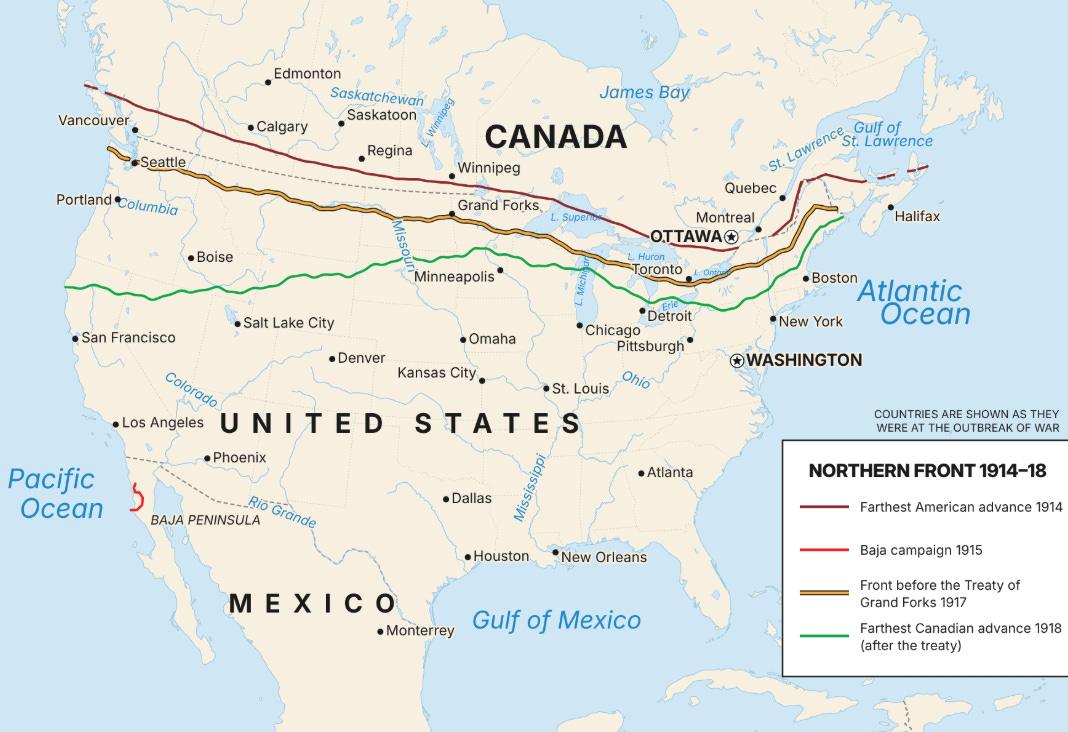
The last time the US faced such a military challenge was in 1865. While organizing a party and a movement is always the right thing to do, these must be tempered with the correct material analysis; if the core imperial American territory is not threatened with hostile military invasion within our lifetimes, what is to be done has an entirely different set of answers.
I don’t know what those are. No one does. No one has ever established a communist or leftist sovereign entity in a Western country absent massive military operations. The French Revolution, the Paris Commune: both were borne from the upheavals of an invading Prussian army, both times. Even Cromwell’s English Revolution was mostly due to an invading Scottish army plundering northern England, spurred on by the King’s incompetence.
Other than waiting (and perhaps, hoping) for domestic military reversals, the left needs a different set of answers. Absent a war that touches American shores and territory every day, what should be done will and should be different from what Lenin or past revolutionaries have done. This is not to say the Revolution is impossible; quite the opposite. It is also not to say we cannot learn from the past, from Lenin and the rest.
Revolutions are constantly occurring; human history heretofore has been a series of back-to-back revolutions: agricultural, industrial, finance capitalist, etc. Whether or not socialists will be counted amongst the successful revolutions, yes, depends on the material conditions of society, but it also depends on how the left is organized. If Lenin did not create and lead the Bolsheviks prior to 1917, Russia’s revolution would have gone to the militarists, to Krasnov and Kerensky and their ilk.
Given that capitalism is built on successive crises, the revolutionary moment will come again. Whether or not the moment fizzles out with a reform that bandaids society’s problems or if the moment expands into a true revolution, depends on how the Left is organized.
Thus and therefore, if there is any lesson the Left can take from Lenin, or from any other revolutionaries, it is to be prepositioned and prepared with the right policies, the right leaders, the right attitudes, the right ideologies, such that maximal advantage can be taken the moment the spark is lit.
Even if there is no hostile military invasion to contend with, the Left can still use crisis moments to radicalize the population and move the overton window forward, capturing more and more political power in the process. Even if soviets are not established now or in ten years, having loyal partisans in the halls of power will help shield and grow nascent socialist power. Over time, either in generations or in the spark of a momentous week, socialist power can and will entrench in American society, eventually becoming the immutable law of the land.
That is what we must work towards.
That is what we must do.
Urlanis, Boris (1971). Wars and Population. Moscow p. 85
https://web.archive.org/web/20160304192437/http://www.oldru.com/army/18_01.htm
https://web.archive.org/web/20110514135653/http://az.lib.ru/p/paleolog_m/text_0010.shtml
https://web.archive.org/web/20121016035825/http://zlev.ru/75_2.htm
Martynov. The Tsarist Army. P. 206. Quoted from: Richard Pipes. The Russian Revolution. Book 1. The Agony of the Old Regime 1905–1917
Raskolnikov F. militera.lib.ru/memo/russian/raskolnikov_ff/02.html
http://hist1.narod.ru/Science/Russia/Fevr1917.htm