

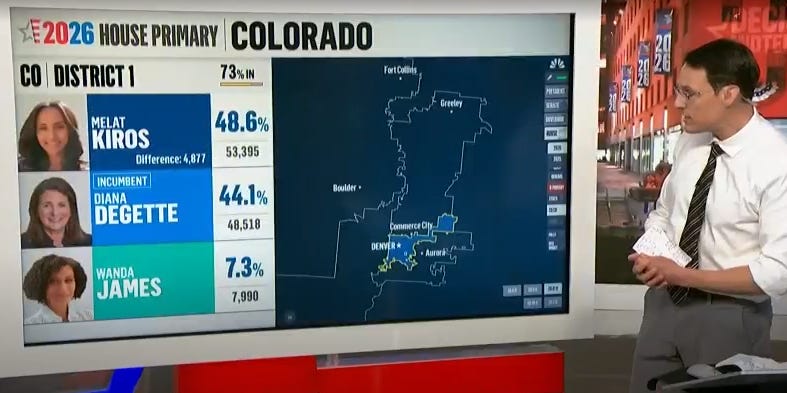
A great realization has suddenly gripped the political establishment of the Democratic Party: they have lost their voters, the institutional bedrock that allowed them to lord over the Party for decades. The hue and cry has gone up; the electoral disaster for the center portended for years has finally arrived. Not only has the DSA won seats in NYC, but now they’ve started to win in Colorado, knocking out a 30 year incumbent(!) in the process:
The first warning sign came in 2024, when the party and its nominee failed to turn out millions of Biden voters, handing Trump his second term. While many establishment Democrats could and do still blame the voters for their folly, the buck stops at the top, the same top which oversaw a rise of baseline inflation numbers to double digits, and which saw an unfit President effortlessly renominated and then removed from the ballot.
New York City’s 2025 mayoral election was the next portent. Zohran Mamdani was fated to be an also-ran at worst, or a Maya Wiley at best—a “moral” victory for the Left; in other words, just getting the message out there (about affordability, or universal healthcare, or abolishing the police) would be the victory in itself. There was no way Zohran could win; just getting him on the debate stage, to make his message known, would be the prime victory socialists could dream of achieving. This is precisely the ambition the hard left has had for decades, going back to when debates started getting televised. Every two or four years, the socialist left and libertarian right sets their goal on the most attainable height for them: just being allowed to deliver their message to a primetime audience.
But then, Zohran won. Not only just the primary, but the general election. And, in case people thought this was a one-time fluke, that Zohran possesses some ur-political talent never again to be repeated, the Democratic Socialists of America have added another two impressive heads to their collection of incumbents overtaken: Adriano Espaillat and Diana DeGette. Both DeGette and Espaillat are incumbents in the House; DeGette herself has been there for 30 years!
In a normal world, with normal elections, Espaillat and DeGette would not lose their reelections. Espaillat would coast to reelection, absent any major gaffes, and DeGette would die in her seat like so many other members do; the seat having transformed into nothing more than familial sinecure one might find more in the ancien regime of France than modern America.
I’ve written before about the centrality of Israel as the core explanation behind this fall in the center’s fortunes, but it bears repeating: supporting Israel is the prime electoral killer in Democratic primaries. Absent Israel’s genocide in Gaza and the Democratic Party’s bear hug of that genocide, these centrists might have survived. This should be obvious, and should have been prior to 2026!

Since 2015, when Israel’s kahanist leader, Netanyahu, showed up to Congress without an invitation from then-President Obama, to damn and shame the President’s JCPOA peace deal with Iran, Israel has been increasingly unpopular in the Democratic Party. You cannot show up to the floor of Congress and attack the popular Party’s popular President’s policy and expect to remain beloved by that Party, especially if you represent an entire country. And, this of course was the same JCPOA that Trump ripped up, which in turn led Trump to start the war we just lost with Iran, which will lead to who knows what terrible, unforeseen future. You cannot be a loyal, partisan Democrat and stand side-by-side with this pro-Republican, war criminal hack. It’s that simple.
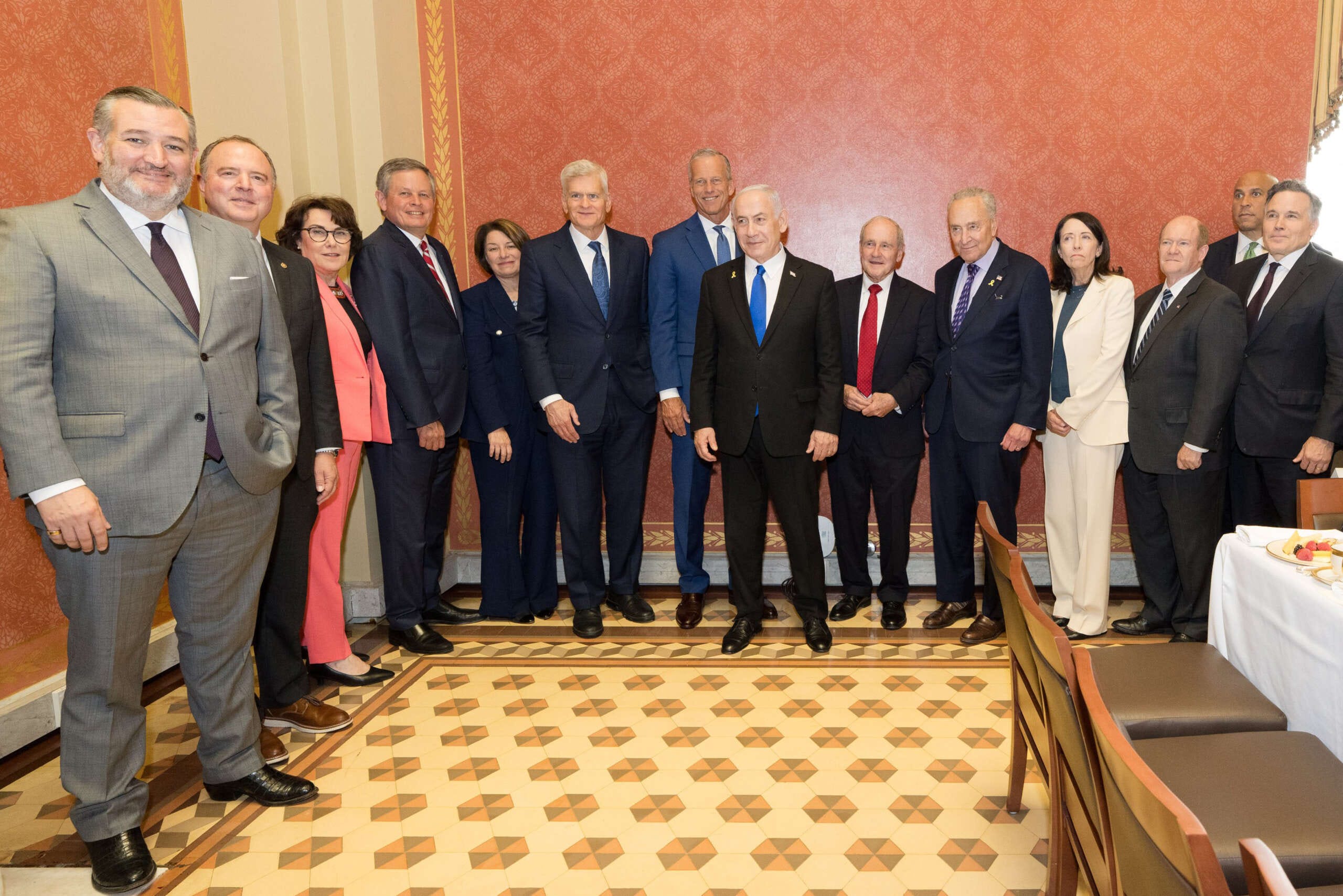
Of course, everything Netanyahu and Israel have done since 2015 has only escalated and made more plain how much Israel is an enemy of not only the Democratic Party, but of the United States. Just like arguing that Biden should serve another four years, this is like tilting at windmills for the Democratic Party; the sun has set on this argument—you will never convince a majority of Democrats ever again that Biden is not too old to run for reelection, just as you will never convince a majority of voters that Israel and its ruling coalition does not hate the Democratic Party and everything we stand for.

This cannot be undone, just as the genocide in Gaza or the Holocaust, or any other infamous crime, cannot be undone. It has been done. Now we must live in the wake, in the aftermath of the horror.
The DSA tendency has benefitted from being amongst the first to be morally correct on Israel and Palestine. Of course, Leftists are often correct first; the difference from the DSA and other past Leftist tendencies is that the DSA organized themselves electorally from the ashes of the 2016 Sanders campaign, overtaking the then-moribund organization and transforming it into what could best be likened to the DLC for the Left, though it is far more mass politics than that. As such, given that they’ve been organizing since the first Sanders campaign, their continued ballot success was both predictable and seemingly inevitable. As soon as Israel began enacting their final solution for the Palestinians, whatever center held for Israel within the American Democratic polity washed away, replaced only by fervent opposition to the zionist entity.
The very first thing any Democrat must do to survive electorally is to drop Israel. This is obvious, but must be stated plainly. Winning a Democratic primary, across most states, means winning a plurality of votes. That’s it. It is against the law to bar people from running in primaries, from establishing loyalty tests or even donation tests, in order to vote. This means that the DSA, or anyone, can run in Democratic Primaries, and win, if the voters choose them. As such, Democrats who hope to win must secure a plurality, and as a plurality will henceforth oppose Israel no matter what, Israel must therefore be opposed no matter what. How that opposition takes shape will depend on specific policies; the treatment of South Africa and Rhodesia are examples for policy potentials. I imagine both the DSA and the non-DSA will have their preferences; both could benefit from that struggle of debate (as I keep repeating).
But, the point is clear. No more will Democrats suffer candidates whose sole purpose is “to keep the Left pro-Israel” (Schumer) or candidates who “see Israel in my dreams” (Stevens).
But, excluding Israel, what exactly does the DSA believe in? Here I turn to the notion of how to beat them; not that I think it’s a good thing that they be beaten, but rather, that I think that without getting challenged in this way, they will never actually win, and that their definition of victory may be ill-defined.
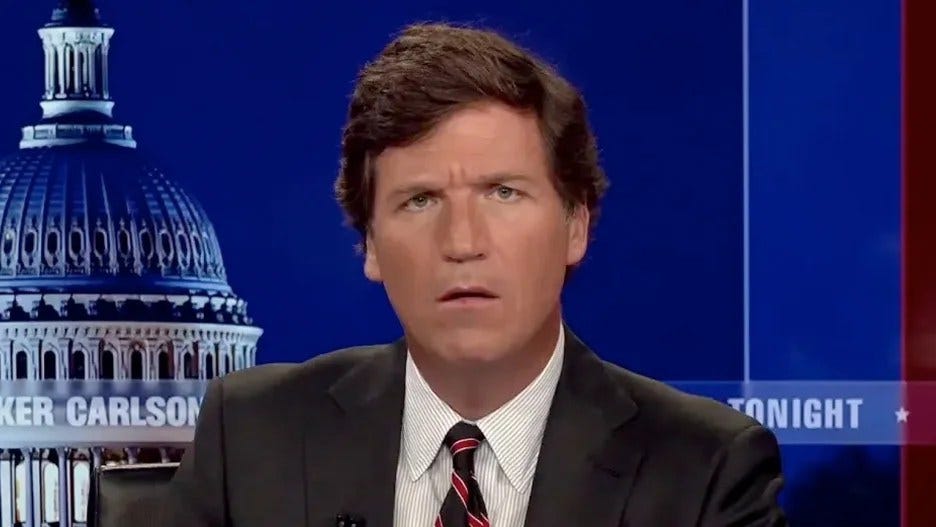
Here, I think of Tucker Carlson. Hear me out: just as he turned to Mike Huckabee, our ambassador to Israel, and asked him what that means (about several zionist talking points Huckabee kept repeating), we all should do the same thing to democratic socialism.
Democratic socialism. What does that mean? First, we must define socialism. Many will provide a million different explanations, but for most, what it means is the precursor to communism, with communism itself being little more than the nonreligious eschatological realization of Abrahamic prophecies. Communism—a classless, stateless society, rid of want, pain, suffering; is this not Christ’s millennium, the Mahdi’s return, the Messiah’s new Israel? It is—and it is not. Unlike those other traditions, socialists believe that through advancing and improving material conditions, such a heavenly state on earth can be arrived at through human toil and work alone, without divine intervention. Agree or disagree, it is the central thing that drives them. When Darializa Avila Chevalier or anyone else talks about abolishing the police and prisons, or other seemingly impossible, unworkable ideas, they are talking about nothing more than the eschatological realization of Marxist philosophy.
As it is, that’s not a bad thing. A core critique of liberalism that I have is that it lacks an eschatology; what the liberals to me always seem to say is: if you want to picture the future of humanity, imagine the stock market’s boot on humanity’s face, forever. The world as it is is the world as it is; things may improve but there will always be classes, always be borders; there will always be cops, be repression, be genocide. It offers absolutely nothing to those who want to be part of a multi-generational movement, one that exceeds the bounds of their own lives to transform the future.
The problem for the center and for liberals, beyond their lack of eschatology, is that they lack the simple, crisp policy alternatives the DSA Left offers. Consider the policies many DSA candidates champion:
Single-payer Medicare for All (or just universal healthcare)
Defunding the police/refunding communities
The Green New Deal
Taxing the Wealthy
These policies enjoy, in various framings, majoritarian support in the Democratic Party. This isn’t because these are radical, fringe ideas, but because they are incremental continuations of Obama’s policies, merely expanding upon the framework the incredibly popular former President championed.
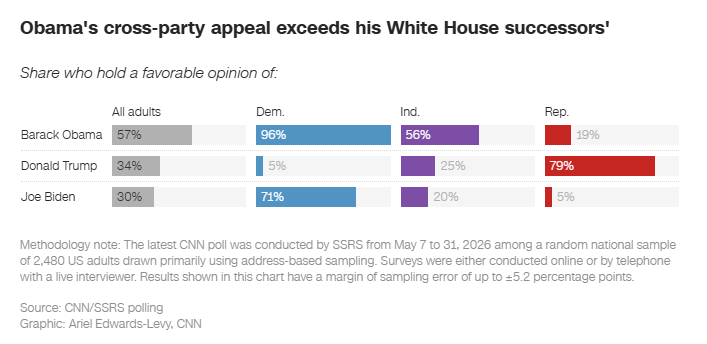
The whole ideological precept of the Obama administration was this idea of progressive, incremental reform. The Affordable Care Act, Dodd Frank, the Stimulus: none of these were meant to be the final word on healthcare, on financial reform, on domestic economic policy, and so on. Bernie Sanders, and then the DSA, merely picked up the banner Obama carried, hoping to keep pushing incrementally on these policy areas. What, after all, is M4A if not ACA’s logical continuation?
Obama, of course, was not a radical. His beer summit, pitting a cop together with his victim, was the best example of this. He tried to bridge the gap in the party, between those who still loved private insurance, loved the police, loved carbon fuel, loved the rich, and those that did not. To the extent it worked, it is a moot point now, for many of those people became Republicans, even fascists, anyway. This does in turn mean the Democratic Party can no longer rely on wealthy and corporate donors as reliable wheelhouses (considering they are mostly all fascists nowadays). But really, considering how grassroots-funded campaigns often still win, and that the attentional power natural charisma can overcome even a deep funding gap, it should be no problem for Democrats to abandon corporate PAC donations (wishful thinking, I know).

The center cannot stand in opposition to DSA policies, not just because these policies are popular, but that they were championed and supported by the most popular living President. A retreat from Obama era policies is a retreat not to Clintonism but a full retreat to Trumpism; there exists no alternative policy pole in the party, no matter how many think tanks named the ‘American Happiness Institute’ or whatever sprout up.
Just look at Mayor Mamdani’s housing policy. He is enacting more of the supposedly centrist Abundance Agenda in New York City than even the prime Abundists thought was possible, breaking ground on more and more new housing each day. Bernie’s Medicare for All push in 2015 was nothing more than Obama’s Public Option push in 2009 given more oomph, just as Mamdani’s Abundance agenda is the Ezra Klein Abundance agenda with more oomph.
Govern well and expand Obama-era policies on healthcare, on the economy, on foreign policy, and you will do well as a Democrat. Simple enough! But if it were that easy, the DSA would not have won its elections. It all comes back to Israel, which to many is a signifier. Giving Israel a carte blanche to do a genocide makes everyone doubt your commitment to basic human rights at home; only bad people support bad things, as it is known.
To be clear: if the Democratic Party does not abandon Israel, then the Democratic Party will become the DSA. If you are a member of Congress, or a staffer, or whatever: join your local chapter today, because the Democratic Party will likely cease to exist very soon if it does not become fervently antizionist. In case I am not being clear enough, every single Democratic primary voter is saying and agreeing with the following:
“You shall not crucify mankind upon a Star of David.”
Yet, beyond Israel, the question remains, the question that may very well upend democratic socialism: beyond the eschatological, what does democratic socialism mean, in terms of policies and how they can be achieved? Is communism something that can be enacted in our lifetimes? Here is where the distinction becomes critical. If the police or prisons are something that can be abolished in our lifetimes, how? That is the key driving difference, and should be. Either we are meant to accelerate into a revolutionary, totalizing moment that leads to immediate satisfaction in our lifetimes, or we are meant to keep incrementally building upon President Obama’s stable foundations.
If a DSA member became President, what relations would that person have with China, the world’s only other supposedly socialist power? China, it should be noted, sends Premiers to the World Economic Forum to deliver keynote addresses. Meanwhile, the DSA views the WEF as nothing more than a punchline on their podcasts.
What will the DSA’s economic program be? Who will write it? Which caucus in the DSA will be in charge of drafting it? Do they intend to copy China’s industrial policy writ large? If so, how do they plan to transition the United States from a consumer economy to a producer economy without lowering the domestic standard of living?
Trump’s tariffs should be repealed, but then what should our trade policy be? What should America produce and purchase on the world stage, not just in 2027 and 2028 but in 2050, 2070, 2100, 2150? What is the longterm economic vision of their movement?
If the DSA plans to introduce some level of central planning and economic stimulus (this is less socialist and more étatist, an important distinction), how much involvement will private industry have? Will the United States still have billionaires? China does.
Will they be more anticapitalistic than China? Will they seek to abolish the stock markets? How will they resolve the resulting tension of having more than 60% of Americans owning some form of stock, typically to augment their own retirement savings, or of half the American population working in or owning a small business? What role will small businesses have in the DSA-led economy?
If prisons are abolished, what happens to the murderers and rapists? If police are abolished, what do we do about mass shooters? Terrorist attacks? Even the most hardcore police abolitionists have red lines, where they themselves would call the cops, if no other alternatives were available.
This is something the non-DSA must also answer, of course, for each point.
To be clear, I find myself in total agreement with those core socialist desires. I want to live in a world without exploitation, without classes, without suffering, of any kind—an escape from the endless cycle of hell we find the present conditions to be. There should be no police, or prisons, because nobody should be getting raped or murdered. There should be no stock markets, no small businesses, even no jobs: you should not be forced to work for someone’s pleasure and profit in order to feed, house, and clothe yourself. “From each according to his ability, to each according to his need,” remains the foundational ideological principle which holds the moralistic lodestar of the Left.
But when, but how: these are the questions that splinter the Left, and always have. Obama’s (and before him, F.D. Roosevelt’s) incremental Lassalleanism attracts because it is proven to work. Change takes years, takes decades, but in geological time, even in anthropological time, such a time frame is nothing more than a blip, and it always does happen. The center never holds, things fall apart, and the polity is rejuvenated by this metaphorical circle of policy life.
I myself may not live to see even a better, more socialist world, but I am not so selfish enough as to think that everything is about mine own pleasure. Forced to answer, many in the DSA will agree with this proven track record; the immediate abolitionists of the present state (anarchists and neobolsheviks alike) will be forced out, their fringe desire for violent and bloody confrontation spooking the rest of the movement, as it always does.
Therefore, if the Democrats hope to beat the DSA (and again, I think they both deserve the challenge more than the defeat), they must do the following; otherwise, they will surely lose:
AGAIN: Abandon Israel as an ally. This is obvious. If you want to keep seeing Israel in your dreams, or keep any segment of the American polity pro-Israel, go be a Republican. This isn’t your Democratic Party anymore. The voters have rendered their judgment.
Come up with a theory of the end of time, of societal eschatology. Even Obama had this—his was “we will do all these good things, reassess, and then keep improving upon them, until they need no more improvement”. Democrats under Biden lacked this; the message was to stop Trump’s fascism, but then what? The end of Trump was the goal itself, and when that was achieved in 2020, the main ideological impetus of the Biden movement died. Of course, Trump did not end, but framing his electoral defeat as the sole purpose made Biden’s ideology ultimately far weaker than Obama’s.
Do the Tucker Carlsonian thing of begging DSA members and talking heads to answer the question: what exactly they mean by “democratic socialism”. You should agree on the obvious continuations of Obama policy, and disagree where it is obvious to do so. Below, a conversation between two straw people to illustrate this point:
DSA Strawperson: I support abolishing the police and prisons.
Democratic Strawperson: What do you mean by that?
DSA Strawperson: I want to live in a society where we don’t need police and prisons because people aren’t committing crimes.
Democratic Strawperson: I think everyone wants that. I too want to live in a world without crime. But how exactly do you propose we get there?
There are policy ideas the DSA Strawperson could offer, of course, ways to get there incrementally. The Democratic Strawperson, I bet, could even come up with their own incremental reforms. This is good, this is politics. Debate is good. The goal is to define a presentable, realistic policy: what should prison and policing look like in the 2030s? How do we lower crime without increasing police abuses? What lessons from the 30s will we apply in the 40s? And so on; the people desire empirical analysis, of changing what doesn’t work and upholding what does.
If the DSA Strawperson responds with immediate abolition, or with the same haughty “I just believe in this” without offering specific policy ideas, that can and should be attacked as intellectually weak. This is where the Carlsonian skeptical line of questioning is so powerful, so critical. Left unchallenged, DSA candidates may very well coast to defeat in general elections, leaving their unpopular, unworkable policy ideas unsaid in primaries.
But they should only ever be challenged on specific policy differences, where the meaningful difference is the power that they as elected officials will actually wield, versus whatever personal beliefs they hold. In an ideal world, we should all be in broad agreement; call it Communist eschatology or Abrahamic or something else: we all desire to live in a better world.
Another example, to home in on the point:
DSA Strawperson: I support cutting the military budget.
Democratic Strawperson: I agree, we should cut Pete Hegseth’s Department of War’s budget. But how? How many aircraft carriers should the United States mothball or otherwise scrap? What do we do with all of our alliances, all of our treaty obligations in Asia and Europe? What is your theory on naval and aerial power projection? Should we have an army at all?
The hope for the Democratic Strawperson is that the DSA Strawperson answers in the most radical fashion, such as: I support total military abolition.
To which, the Democratic Strawperson can respond: Okay, but even ignoring our actual geopolitical opponents in China and Russia, do you really trust the rest of the world to treat American sovereignty with respect? Do you trust the Europeans? The Spanish, the Portuguese, the Dutch, the French, the Germans, the English? 500 years of recent colonial history in the Americas proves we shouldn’t leave defending our borders to anyone but ourselves.
Of course, the DSA will be for the eschatological point: border abolition, state abolition; a one world government where all such distinctions melt away, before the government itself withers away. Again, nothing too disagreeable, from a heaven-bound philosophical perspective. It is the how, the specifics, the when that the Democrats should use to trip up (and thus refine) the DSA.
For as AOC showed in Munich: the Left is not ready for primetime on questions of foreign policy and national security. They are totally absent when it comes to global economic development, on the world stage at Davos and beyond. This is their fatal flank, where biting rhetoric, the question pressed, will either cripple the DSA or allow them to ascend.
The DSA does deserve this challenge. They have too many tendencies, too many caucuses, too many intra-regional hostilities to survive as-is. Their conventions are most certainly not ready for primetime, having less the feel of a CPAC (when those used to be popular) and more of a statewide student government convention. Certainly a tabloid camera crew could wreck several personalities, just following convention-goers around (no, I am not talking about Hasan, or whatever other nemesis you may have; this is just a stereotypical rendering of judgment).
Is the DSA a diamond in the Democratic rough, or just the coal for a stronger Democratic Party, or the precursor to an actual splintered-off socialist party? Is the Democratic Party doomed to become the DSA, or shall it consume the DSA like it consumes all other factions?
Both the Democrats and the DSA deserve and need this fight like a bird needs to chirp and feed its young. It is an institutional imperative for both to fight—and let the victor be both, neither, or either! And let the majority of America which supports these broad policies (60-65% of the electorate supports Democratic/DSA policies) enjoy the succor of seeing those policies actually enacted by a honed and refined political tendency that can not only win power but hold it.
So, catch me outside1 (how about that), crying havoc: let slip these rhetorical dogs of war! We will all benefit from the struggle.
I didn’t leave the Left or anything, I am literally too deadass broke to be in the DSA. Which is why you should
And sign up for a paid sub too, while you’re at it.
Other than the fact I am broke, I am genuine when I say I don’t know what Democratic Socialism means (literally why I want these debates to happen, why these need to happen). So I let my membership lapse. I might return, I might not. Longtime followers of mine know I only support winners. Right now, that looks to be DSA. But I voted for Obama in the past. I’m not too picky, ultimately, so long as I back the winners that get me closer to my version of eschatological realization.
It is not just the genocide in Gaza, as abhorrent as it is, but the legacy dems decision sometime ago to govern only for the uber wealthy, while appearing to placate the progressive voters with social issues. We can do both, and the DSA is demonstrating that.
“DeGette would die in her seat like so many other members do; the seat having transformed into nothing more than familial sinecure one might find more in the ancien regime of France than modern America.”
What a perfect example of the kind of pointless self-directed shit talk that non-DSA Dems reflexively append to any discussion of their party, empowering DSA-style candidates before they wonder where all the “bad vibes” came from.
Do you actually know anything about DeGette? Or just how she fits into a half-assed narrative?
Physician, heal thyself.