

It’s been a little less than a year since conservative activist and overly memed individual Charlie Kirk was brutally gunned down by an assassin’s bullet in an act of terroristic violence. I came to see that bullet hit him not once, not twice, but thousands of times in endless replays across the vast sea of social media algorithms.
I can hear his voice even now, echoing in my head, “Counting or not counting gang violence?” before the whip and crack of the assassin’s bullet slammed into his neck at sound-breaking speeds, an immediate gushing fountain of blood spewing forth from the wound.
Charlie never had a chance to survive, never had a chance to live. As soon as the assassin’s trigger was pulled, his death was guaranteed. The video is still crystal-clear in my mind: as the bullet rips through him, his fists immediately curled into the less-than-aptly-named fencer’s response, as if he was readying himself to fight off the assailant.
But it was no sign of life, only of death.

Charlie Kirk struck the fencing position as he fell, where a person’s fists jab up—an involuntary bodily response to an extremely severe head trauma event. As soon as I saw the bullet rip through him, I knew he was dead. In fact, the bullet itself likely internally decapitated Kirk, rendering first aid or any attempt at recovery impossible.
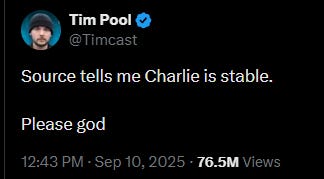
In other words, by the time Tim Pool posted the above on X, Charlie Kirk had already passed away.
Everyone moved on quickly from the now-dead Kirk. His widow buried him in an undisclosed location, and moved to assume direct control of TPUSA. His friends, foremost among them Candace Owens, fought to reclaim Charlie’s legacy in other ways. And yes, his enemies, on the left and right, laughed and laughed. Many of them are still laughing.
I never laughed.
Throughout this whole epoch since his death, not one person has asked: what if? What if Charlie didn’t have to be dead? What if we could bring him back to life?
I can hear the naysayers now.
Insane! Madness! Impossible! How dare you!
Silence, and I shall answer.
Let’s be clear about the medical and scientific challenges first: Charlie Kirk is dead. His corpse has been rotting in that undisclosed location for nearly a year, and will likely continue to do so for the time being. While he should still have his bones and some of his skin relatively intact, his internal organs were likely embalmed and filled with toxic, preserving fluids. While the embalming would allow his corpse to keep its structure for up to fifty years in the best of conditions, the reusability of his embalmed organs is highly dubious. And, it leaves aside his brain, the most important component: the collective sum of his memories, of his experiences, of his personality, which by this point have disintegrated into denatured proteins and amino acids, the information stored within totally and irretrievably gone, forever.
Doctors, of course, can restore the technically dead to life. They do so all the time, in emergency rooms and hospitals across the world. Most successful resurrections happen within five minutes. Anything longer than ten minutes is seen as fancifully impossible, with the cumulative brain damage extremely difficult to undo; hence, the vegetative state.
But, what if it wasn’t? What if we could bring someone back, who had been brain dead for an hour, a day, and so on, longer? What if we could restore their brain, sans memories, to working function? And if we would do that, surely we could restore the rest of the body as well?
To be clear: what I am proposing here is a multi-year, multidisciplinary, multi-billion dollar Manhattan Project-style initiative to locate a person dead for over a year and restore him to life.
Now again, questions abound, foremost among them being why and how.
I will tackle the latter first, as although it is the more complex, it is also the easier to dispense with: I don’t know how to bring someone back from the dead. If I could, I would simply travel to Charlie Kirk right now, and say, “get up and walk”, and he would. But I lack that power myself. Rather, what I do know is that science is advancing all the time, especially medical sciences.
We are relatively certain now, in 2026, that life on Earth began thanks to self-replicating ribonucleic acids (RNA) evolving over time to eventually become DNA and then the single and multicellular organisms we are all familiar with. When Covid hit, we further established that humanity could utilize messenger RNA to develop vaccination protocols; the mRNA vaccine contained instructions for our bodies to create harmless versions of the spike protein the Covid virus used, which our immune systems then fought, teaching them how to fight the actual Covid if and when we got infected. We can even use mRNA and stem cells to grow human body cells in laboratory environments; with synthetic lab meat already in existence (and edible!), it seems inevitable that we will one day be able to grow a full human organ, ready for transplant.1
And, if we can regrow, say, a heart, we can most assuredly regrow the full body, from the skin to the bone marrow, to all the individual organs from heart to liver to stomach, all back to their original forms. Once Charlie’s body has been recovered, we will have direct access to most of his genomic data. Assuming that his family cooperates, we could even reconstruct it from scratch if needed. Replicating his long-decayed and vanquished organs, such as his liver or his stomach, would be costly, time-consuming, and difficult. But possible? Oh yes, most definitely.
What of the brain, though?
Even assuming that neuronal regeneration can be done (like the regeneration of the other cells of the body), we likely will never be able to restore his full thoughts and memories. If the brain can be likened to a computer’s hard drive, then all information not backed up is lost forever. We currently lack the ability to create backup storage for brains, after all.
However, it may still be possible, through some manner of electro-neural stimulation, to encode data inside the new data-vacant neurons. We can work with his family and friends, those who knew him best, and attempt to encode facsimiles of the experiences the unadulterated Kirk once lived through. It will be an approximation, and perhaps many months and years will have to be spent re-teaching the reborn Kirk how to walk, talk, read, and write. But if it takes 2 years or 200, the result will be the same in the long-run: Charlie Kirk, once dead, now will live again.
Now we must tackle the why, and here, we can break it down into several components.
Why Him?
Of all the people who have ever lived and died, Charlie Kirk is one of the few who could be brought back to life. It needs to be someone:
Who died recently, in living memory (if they are too far gone, the genetic material inside their body could have decayed; and, no one will fund it or care much if the person is too far removed from the living)
Who died before their time—we can all agree Charlie was untimely ripped from us.
Who can have bipartisan support for his resurrection.
That last one is the rub. Who would support the resurrection of Charlie Kirk? Well, first, obviously, the Republican Party. Since his death, they have been lacking in any sort of replacement figure that could step into his shoes. If he magically came back tomorrow, they would all rejoice; I am proposing to bring him back without using magic. And yet, why would the Democrats support the resurrection of their sworn foe?
Because they know Republicans would support it if it could bring back their promised prince, thus making it possible as a bipartisan budget item.
And, most importantly for them, because the Democrats will know that if a person like Charlie can be brought back, so can anyone. No one would need to die anymore; Charlie’s return would be a great, bipartisan proof of concept that would, for once and for all, conquer death. That it brings back the foe-enemy of the Democratic Party would be the ultimate sign of unity and charity, one that will forever bridge the partisan divide as humanity enters a new, deathless epoch.
Why Resurrect?
Who wants to live forever? Few people alive today will admit that they want a living eternity for themselves, relying either on the promises of ancient scripture or on their own depression to keep them down.
To focus on the scriptures, just as we now know that life on Earth likely arose from RNA synthesis, we now know that the New Testament was written mostly by Greek converts and Greek Jews, who lived long after Christ’s death. We know better than any previous generation that these Greeks perverted Christ’s teachings for their own benefits and purposes.
We know that beyond the first three Gospels, (Matthew, Luke, Mark, which mainly focused on reporting Christ’s words and deeds as they were), the teachings of Christ were perverted to be acceptable to a Greco-Roman audience, with its core teaching (that of universal love) utterly downplayed. All the latter books of the Christian Bible, save John’s Apocalypse, became wholly and solely concerned with personal salvation, with universal love an often-forgotten afterthought. The whole faith, led by the falsifier and revisionist “Saint” Paul (who never met Christ!), became about this, with universal love totally forgotten. Just count how many synods and Church councils met to deal with the nature of Christ’s various natures, and you can see where their focus was. Or, just observe what the Christians did once they had an ounce of temporal power, and you will see how far the doctrine of universal love carried them; across the many centuries, from the Albigensians to the Indigenous peoples of America, to the various peoples of Asia and Africa and besides, the learned Christians offered to the world only genocide.
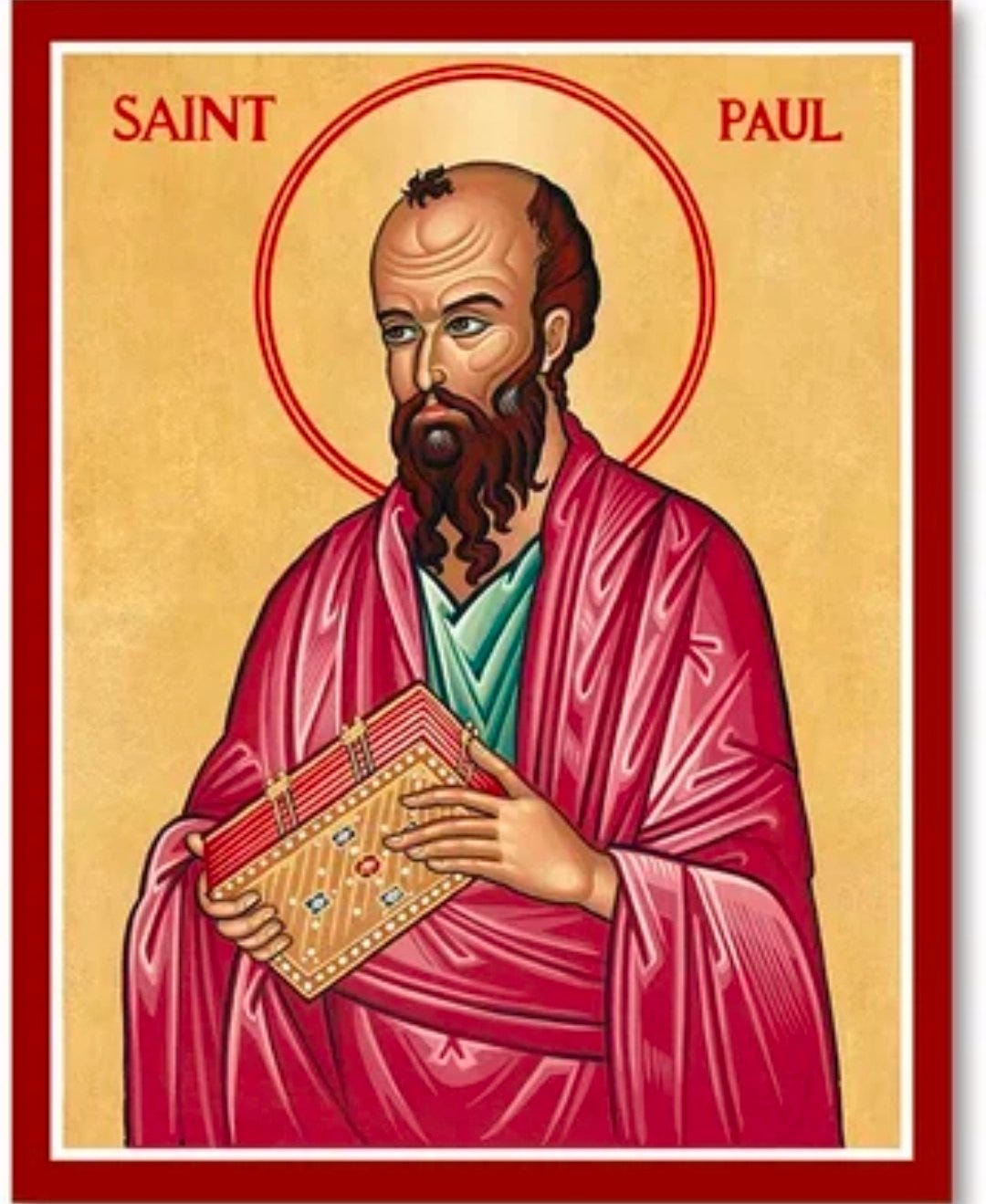
Yet the last book of the Christian Bible, John's Apocalypse, shows the way in one of its final chapters:
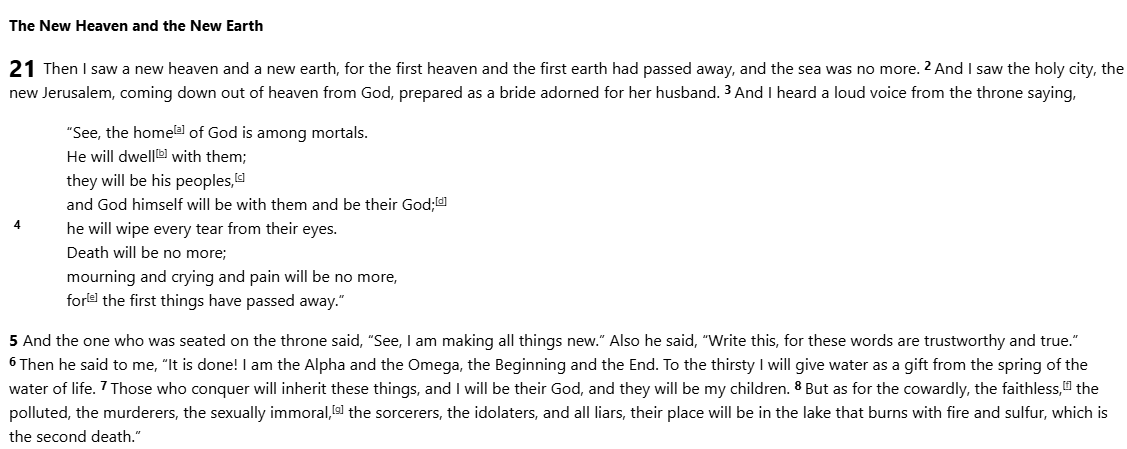
The traditional Christian understanding is that Christ will return and usher in a new millennium, with all the heavy lifting done by Christ’s mighty and sole hand. The Commandment here, read this way, is for humanity to do nothing, and wait for God’s infinite pleasure to kiss their brow.
Yet, who will build the new Jerusalem, the home of God amongst the mortals? Surely, the mortals must build this new home, worthy of God, for they have built everything else by their own hands and own toil, from the old kingdoms of the world right back to when the first bits of RNA were synthesized: we, the living, acted, not God.
That death will be no more is not a finger-snap or mere wish of God, but the product of eons of hard toil.
And, we can achieve it. We can conquer death, as I laid out above. Thus, the words of John in his Apocalypse can indeed be prophecy.
We will bring people back from the dead. We will start with Charlie Kirk, and prove that death is no bind to us.
All tears will be wiped away from our eyes. Death will be no more; mourning and crying and pain will be no more, for those things have passed away.
In that brave new world, all things will be made new. To the thirsty, to the worthy, to those now living and those now dead, they will drink freely from the waters of the spring of eternal life; a spring we, the people ourselves, dug and claimed2.
See? We are making all things new.
Let these words spread! For they are trustworthy and true.
Amen.
We have already grown a mini-heart!: https://www.nhlbi.nih.gov/news/2023/mini-hearts-dish-big-win-cardiac-research
But the cowardly, the faithless, the polluted, the murderers, the sexually immoral, the sorcerers, the idolators, the liars: we shall not restore them to life. Their place is oblivion, where they shall experience a second, final death: the death from which there will be no return. We shall send them all out to a lake that burns with fire and sulphur, where there shall be much weeping and gnashing of teeth.