

How will our world end? How will humanity, living and vibrant today, go extinct? More importantly, what happens between then and now?
At the extreme end, in about five billion years, a little longer than the age of our planet, our Sun will either consume our planet entirely, or push it out of solar orbit, or otherwise become so dim as to render our planet a giant ice ball. Assuming Muskian dreams of fancy of extrasolar humanity are just that, dreams, then we know there is a definitive end coming to the human experience.
Even if it’s not the sun, but rather a bacteria, or an asteroid, or our nuclear weapons, etc.: we know that human extinction is rather unavoidable. We can be relatively certain that it won’t happen in our lifetimes, or in the lifetimes of anyone’s great-great-great grandchildren they might have; perhaps tens of thousands of years yet remain in humanity’s ticker.
After all, how can things not get worse? Such has been the trend unto this point, such will continue to be the trend long after we are all dead.
But suppose this were not the case, that immutably, things must worsen. Then we must ask: how will human life look like then, five hundred, five thousand, five hundred thousand years from now? If humanity only becomes extinct in, say, 1 million years from now, that’s still an extra one million years of existence, hundreds of billions of people living across that vast expanse. And, in considering this continued existence, we ask: could it be better?
Oh, but of course, we know their collective lives could be far worse. At the far end of the spectrum, we could keep humanity caged like their lesser animals, fed synthetic slop before being culled to either feed or power greater beings. We could kill them all, smash their atoms and their memories into quantum dust, forgotten beyond the edge of time itself, their senseless murder pointless beyond the immediate thrill.
But we are not gluttons for torment. We, humans, desire liberation from our torments, our ails, our pains, our collective struggles. When there is conflict, we desire peace. When there is hunger, we desire food; we are all base animals, with base instincts, yet possessing higher reason and cognition than other beings. No one wants to live in a rot-infested dungeon, clinging on to a painful life of endless torment.
Our dreams are heaven-bound. Even if not religious, every person imagines how their life could be better, even from one moment, to the next. A person driving down the highway will merge into a slower or faster lane that befits their personal needs and wants. A hungry child will look at a loaf of bread with enough wanting to compel a father to act, even at great personal risk. Even if no one acts, the mouth’s involuntary watering reveals the truth of our desires.
So yes: not only could life be better, but there is a true universal desire for life to be better. This desire is birthed out of the Hegelian dialectic, the competition and debate between two or more existential truths that cannot co-exist together for long. In physics, matter and antimatter cannot cohabitate the same space in time; so it is true for the essential other building blocks of society, of human interaction with the physical world.
The person who wants to merge into a slower or faster lane is compelled to do so via a contradiction: a desire to go faster or slower; yet, their car is moving in a lane that does not match the desired speed. From that contradiction, there is conflict: internal, roiling mental conflict, which exists in that limited liminal space of mind for only a moment before it impacts the material world. Then the turn signal is flipped on, and a choice is made; the merge is made, and the person’s relative speed in the real, material world changes as their car changes lanes.
Without some contradiction, there would be no desire to change lanes; indeed, no desire to drive, to eat, to even live a life. Contradiction is the essential law governing human interactability with the wider world; it powers everything we do and will do.
The central key contradiction in human society at present, since the rise of settled agriculture for the past ten thousand years, has been the rule of the few, over the rule of the many.
Consider the first granaries, built when humanity first settled into agriculture. The granaries would need defending, not just from stray wild animals but from thieves, especially from other communities. Over time, over generations, the first guards of the first granaries became the first kings, securing and lording over the agricultural surplus of the first societies. They wrapped themselves in the shields of surplus and lore, inventing godly rituals, sprinkling tiny seedlings of seemingly divine grace upon the lowly masses, and with that power, ruled absolutely.
But where are those kings now, those noble lineages of yore? All extinct. For the time came, as it always did, that the contradiction of tyranny wrought itself over these kings of old. They abused the masses, bribing a few amongst them with extra rations to help guard the supplies. But there were always more people than a few guards could handle, and crucially, more contradictions.
The God-Kings of the old world did not plan for their demise. They built their societies, their great monuments to last for all time. But Sumer, Egypt, old India and China, all of them were felled time and time again by the contradictions of climate change, of famines, and of crop failures, even before considering the essential human element. When the masses hungered, when their fury could not be bought off by scraping the top of the granaries, nothing could stop them, not all the rituals in the world.
Thus has human history turned up to this point: the few lord over the many until things fall apart, and a great upheaval, a revolution, occurs. But what happens when the many overthrow the few? Thus far, into human history, it has meant the simple replacement of one elite dynasty with another. When the peasant Ming rose up against the Mongol Yuan, they wasted little time in restoring the power and majesty of imperial China, with all its intendant contradictions and hierarchy.
Thus too for Rome, America, even supposedly high-ideal democratic experiments, like the Soviet Union. They all failed to deliver true mass democratic governance, to give the whole people absolute jurisdiction over their states to do with as they pleased. Thus the contradictions continue.
In American society, our contradiction is borne from capitalism, that a select few own stock and land either from birth or connections by chance made, and that this ownership then translates to the ability to control what laws are written and when they are enforced upon the broader society. This happens even as we live in a state that enshrines one vote per person as the law of the land, with corruption and bribery being explicitly illegal. How can the elite few violate such strictures, dominating the political landscape in an otherwise democratic state? They can’t, not without a contradiction arising.
The contradiction leads to struggle. Like opposing states of matter, they cannot occupy the same place in time. This struggle is always revolutionary, and it is always violent, as it is always occurring. Time does not stand still, and the building blocks of the struggle are constantly being erected and destroyed before our eyes. One day, eventually, this struggle will break out in an epochal fashion, to the point no one can deny what they are witnessing before their eyes. That day will come when the center can no longer hold, when the masses are no longer appeased by the treats the elites deign to share.
And capitalism is not built on sharing: it is built on the ideological presumption of seeking the maximal, individual gain for oneself. Those who did not adapt to this great mawing hunger for ever more were long ago vanquished; the idea and logic of the capitalism system is to expunge inefficies. But thus too will they be expunged. For the capitalists will always try to make more money, even if it destroys society, even if it destroys the very thing that makes them rich, even as it births the very contradiction that ends up destroying them.
Marx understood history as developing along these lines, recognizing these contradictions for what they are: inherent and built-in to the structure of capitalism. Thus, we can define and know capitalism. But in defining capitalism, we learn the meaning of communism. For to know a thing, you will not only understand its negation but come to define it. The dialectic continues; so it is with capitalism and communism.
The central conception to Marxism is that from capitalism shall come communism, a predicate to there being a classless and stateless society; a society without struggle, in perfect harmony and peace internally and externally. An edenic blissful state of existence, in other words, where things like hunger or disease have fallen away; where the very notion of contradiction itself becomes memory, entertained only as a passing fancy.
Communism is understood not as a thing that can happen in our lifetimes, but as an ideal to strive towards, as the pinnacle of human societal evolution that we can all point to as the universal goal for all, by all, to all.
The alternative, of course, is to deny the contradiction, and to posit instead, as the liberals do, that capitalism is the final step of human history.
Rather than deny this, let us embrace the horror of that sentiment, and consider what it means to continue the world’s superstructure, the daily rituals that bind our society and being, for all time to come.
The bells are being rung on the New York Stock Exchange. Outside the sepulchre white stone building, a man without a home, high on fentanyl, collapses. He is rushed to the hospital, but too late: he dies. He’s buried in a mass grave outside the city. Inside the stock exchange, news breaks that a merger is announced. Billions are made in a second.
The doctor that treated the man owes in student and housing debt more than he will make in his lifetime. The nurses that helped the doctor with the now dead patient owe more than they’ll make in five lifetimes. The cost of care for treating the now-deceased man is passed onto the next patients which shamble in to the hospital, to the six year old girl who got cancer from living in a building with old arsenic pipes, to the alcoholic 42 year old man with a failing liver, to the 68 year old retiree with a hip issue caused from years of back-breaking labor, and so on.
Each of those people owe more in debt than they will make in their lives. They don’t have time to care about that though, they need to go, go to their next appointment, their next job, their next shift, for the pangs of hunger and deprivation are never far behind. And they know, even not having met the dead man, that they are one bad day, one bad moment from his now eternal fate.
The bells ring out at the New York Stock exchange again. Fortunes were made, fortunes were lost. The dead man who overdosed is beginning to decompose. The stock traders go home; today was a job well done.
This is humanity today. It will be humanity tomorrow, and the day after, for all eternity, in the liberal conception of the future. In 500,000 years or now, there will never be an escape; the bells will ring, and the man, the child, the millions, the billions, will suffer and suffer for the continued pleasure of a minority class of owners, until all become extinct and suffering likewise cease for the human race as a result.
It will always be like this, and there is nothing you can do to stop it. Especially not you, as an individual. Suppose you were out there, with a vial of narcan, ready to go as soon as the man collapsed. Tomorrow, there will be another man, so you camp outside the New York Stock Exchange. Except, there are millions of men like him, overdosing all over the world. And even if you could teleport to them all, give them all narcan, the unrelenting suffering of the world will not cease.
For the great harm is coming from inside the building, not outside.
That which makes a person overdose and die, their corpse meal food for worms, is that which makes us all poor, which makes us all own money to other entities, is that which makes a select minority of people who are born owners rich, that which is capitalism.
Capitalism is the great contradiction that impugns and arrests itself upon humanity like an angry ant hive. It must end, like all contradictions must end, for there is a simple mathematical truth, first witnessed by the ancients: there are more of us than there are of them.
The liberals view time cyclically, as a pattern of elections. The promises made and kept, the policy choices selected or discarded, none of that matters to them; power via the next election is all that matters. But time does not stand so cylically still.
So long as contradictions remain, people will continue to be spurred on to action. Even if no one is actively planning for a revolution, revolutions happen. The masses, with zero planning, seize the main square and the military, for once, chooses not to open fire on them. Thus the regime falls, and a new regime will be put in place.
But the liberals will acquiesce themselves to the new reality, they always do. Matt Yglesias today is a liberal commentarian; in a different life, he would have been a Soviet rail commissar, or other type of Soviet bureaucrat, but he still would have been a liberal. The contradictions will continue until the masses can fully divorce themselves from the past, and embrace the future.
Before we embrace that future, we must understand the present.
The Present
Thus we turn to eschatology, the study of the world’s ending. Granted, the Abrahamic faiths paved the road for much of this understanding. Compared to Eastern religions, which function based on cycles of struggle and benefit both, here there is a definitive beginning and a definitive end to the world. This is not to say that a cyclical understanding of human development is not important, rather, that in a Western context, for a Western audience, in Western capitalism, the subject matter of eschatology will be far more familiar than, say, the Kali Yuga. Marx himself was guilty of eurocentrism, and while we must indeed avoid that in the future; for now, we use Western modes of thinking to firstly illuminate Western audiences, who will be amongst the first to read this.
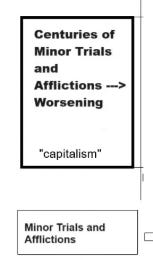
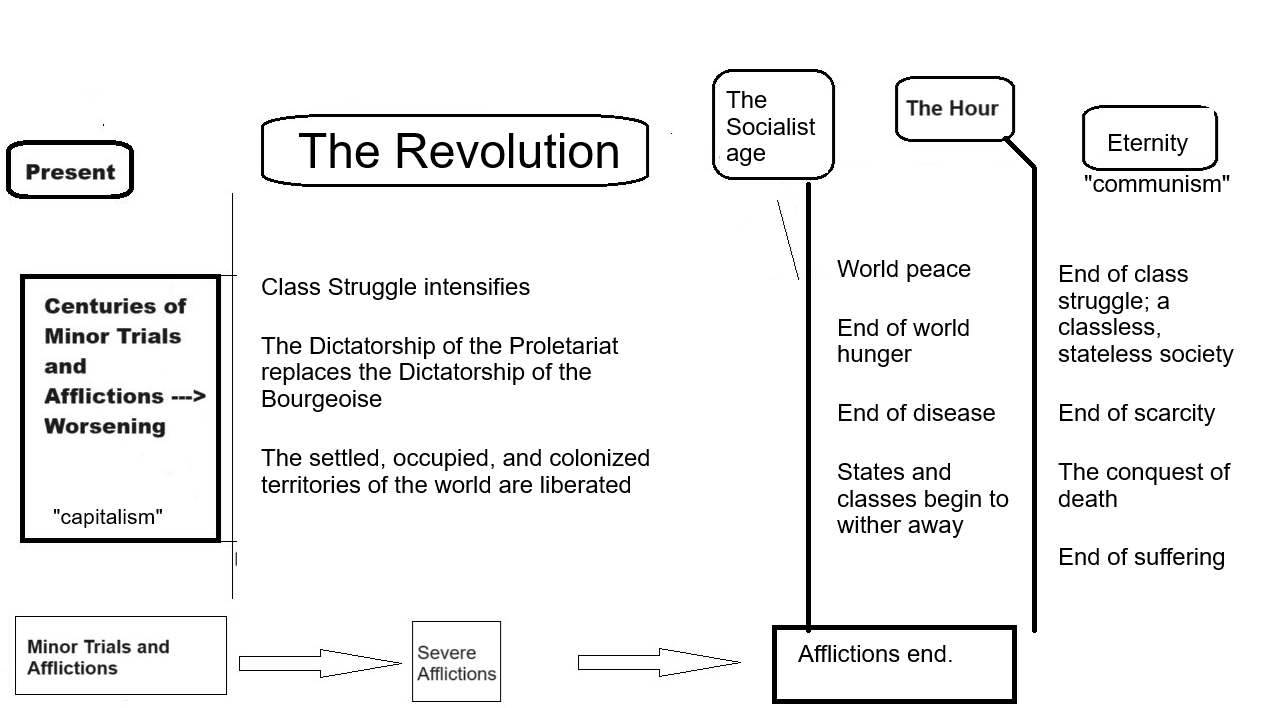
The Present is an era of suffering, of centuries of minor trials and afflictions worsening. No, we are not in ‘late stage’ capitalism; only those living after capitalism will know when the late stage begins. Wool traders in Ghent in the 1330s were practicing capitalism, as were Italian merchants in the 1440s, after all. And they had their own contradictions, being immensely wealthy in societies that prized patrilineal lineage over money. You could be the wealthiest merchant in all of Europe and still be less respected, still have less access to the already unfair legal system than a lowly hedge knight.
These early capitalists birthed contradictions which birthed struggles, from minor ones such as kings routinely being forced to acknowledge ancient town privileges in return for tax revenues to outright rebellion and wars (the English Civil War and French Revolution, for instance).
In the Present, now that they rule over a society they were once peons to, the contradictions have only intensified, as have their consequences. Eight centuries ago, capitalists could barely conspire to start a riot in their local town. Now, with command over most of the countries of the world, they could start a nuclear war tomorrow and wipe out most of humanity in a single flash.
But even without the single flash, the minor trials and afflictions have only gotten worse besides. More people die from war, famine, and disease than died in any previous point in human history, with more dying each passing century from these unnatural causes.
All the while, the few get richer, and the more get poorer. It cannot last. The minor insults, these piling contradictions will eventually force a rupture that no one can prevent, stop, or preempt. The Revolution is coming, and all we can do is survive it.
The Revolution
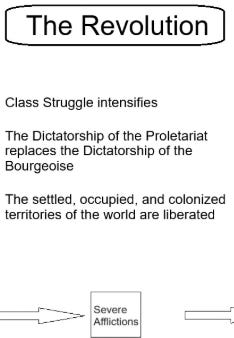
There is not one singular revolution, but many, all happening at the same time, at different levels of intensity. That being said, in sum, all these revolutions will form The Revolution, which itself refers to the epochal break the masses will have with capitalism. It may look similar to past revolutions but what is new here is a true, global revolution, a struggle beyond borders and languages that touches the lives of every single person.
It is not the abolition of the class struggle, of the many replacing the few and then becoming the all, but rather, the intensification of the class struggle. The proletariat will rise up and displace the elite few bourgeoise, and in so doing, select new elites, new bourgeoises elements. Thus will the revolution continue, even intensify, as humanity attempts to replace the dictatorship of the few, of the bourgeoises, with a dictatorship of the many, of the proletariat.
It will not happen overnight; the struggle will shake the very foundations of the Earth. The afflictions and trials we face during this time will be the worst things humanity has ever done itself; it will be a global civil war to truly end all wars.
But in the pyroclastic shade of the ashen falls of the aftermath, humanity will emerge all the stronger, with capitalism and tyrannical rule expunged from our historical lexicon.
This Revolution, it should be made clear, is both unavoidable and undesirable. Absolutely no one wants to live in a state of civil war, much less global civil war. But a communist recognizes the truth, a communist reads between the historical lines and sees the contradictions society built its foundations upon and realizes what Christ and Lincoln both saw: that a House divided, or one built on shoddy foundations, cannot stand.
Thus the communist knows the unavoidable is coming, and so they prepare for the inevitable. For when a revolution happens, it can either be steered backwards to reaction, to the continuation of capitalism, or steered towards the Revolution, to the natural end of capitalism. This is the role of Communists and Revolutionaries alike: not to cause a revolution, but to be there to champion it to its rightful eschatological next step, which is the Socialist Age.
The Socialist Age
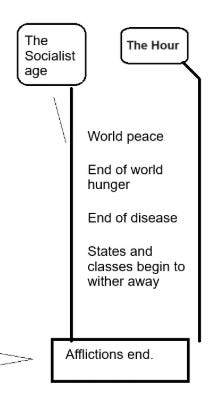
All these struggles, all these violent deaths and delights alike, terminate in the Socialist Age: a time of peace, of wealth, of health, and human prosperity unlike nothing we have ever seen.
True world peace will exist for the first time; not a single person’s life will be unjustly taken from them. Land shall be shared commonly, amongst the people, and things like Putin’s invasion of Ukraine and Israel’s genocide of Gaza would be impossible in this world, for there would be no armies, save the singular world army of humanity, and no state, save the singular world state of humanity.
With the end of war, comes the end of hunger, and then, disease itself. Many of our present ills in society arise from a poor distribution of resources. With the world placed under the command of a single entity, and crucially, with that entity being ruled collectively by the whole of humanity, with its common interests in mind, even things like the Common Flu will be rendered extinct.
The prime goal of the state of this time is to continue exploring the edges of possibility of governance, grasping towards the true final goal of communism, which is the abolition of states and classes alike; their withering away, so to speak.
But for most people, it will be a time without major or minor afflictions. You’ll work as long as you want, in whatever job you want, living in as big or small a house you want, with as many or few people around you as you want. You will never be hungry, never be sick, never know true anguish or deprivation save what you can experience in the memories of those who came before (that is, us, in the present).
Every person will be able to live every extreme that they ever wanted, from joining a monastery to living on a megayacht, to everything else in-between. The world system we construct from the Revolution will support the whims and desires of every human that lives or will ever live. Thus do we define success for the Revolution.
But what next? Is there an end? Yes! The Hour!
The Hour
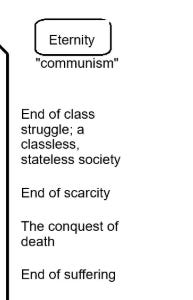
There will be a moment in time in history, in some far flung future, perhaps not even in this world or in this galaxy, where a thing will happen. It will not happen all at once; it is not an event as much as it is a realization. This realization, when collectively realized, will be known as The Hour. For everything prior to The Hour was time immemorial, the recorded history we and they will have had up to that point. Everything after will be everything after: a time beyond time itself, a true endless eternity.
Before The Hour was the turn of contradictions, of capitalism and strife and struggle. Even the Socialist Age portends continued struggle. After The Hour, though, Communism in its true full force and might arrives. And what is Communism, but the ending of everything, excepting life, which itself is fulfilled to its truest potential?
Communism is the negation of all that we know, of the class struggle, of classes and states themselves such that existence universally becomes a classless and stateless society. It must therefore mean the end of material scarcity, even the conquest of death itself. An ideal state of being sans contradictions, a Heaven, an Eden, if ever there were such a word.
It is the fulfillment of life’s purpose, of our collective purpose as a species, to evolve beyond the physical constraints which bind us.
To be a communist is to desire this future, to know the intimate truth that many others deny: that if anything can be imagined, anything can be made real. And because we have dreamt it, because we have seen such a world exist in our mind’s eye, we can make this world a material reality.
That’s What It Is All About
A socialist, a communist, a whatever-have-you, does not simply desire “medicare 4 all”. They don’t just want “the rich to pay their fair share”. They desire nothing less than the universal abolition of suffering in this world and the emancipation of all humanity from the strife of tyranny and struggle. They are the shepherds leading the flock to become shepherds themselves, desiring nothing less than the abolition of class and state. They see themselves as the forefront pioneers and builders of the foundations of a universally democratic, peacefully harmonious society, bound in eternity with immortal grace. Though they are mortal themselves, bleeding and dying with all the fury of mortals, they will never stop existing, for they are borne of the world’s contradictions. When the world ceases to have contradictions, they too will cease to be born, to struggle anew.
And thus they, we, prepare. In constant vigilance we watch for the collapse, for the strife of riotous and righteous revolution to strike the masses, and to thus be prepared at that time to lead the masses to their fullest potential and liberty. Even if the revolution does not come in our lifetimes, we worry not, for we know that the world we build, the world after The Hour, is worth it. In such a world, it would not be impossible to imagine that even death may die, and render the fallen amongst us to return bodily and in mind to that future. Even if it is impossible, we toil still for a world we may never see. For it is worth it; for being confronted with the alternatives of either doing nothing or perpetuating an illogical system that will fall and fail, one that cannot stand across the ebbs of time for all eternity, we choose to act, in whatever limited form or fashion we please.
It will be enough. The contradictions of our world are formed into a veritable house of cards. All it takes is a simple sneeze for it all to come crumbling down. So long as we are there at the bottom to help pick the pieces back up, we cannot fail.
Coda; In Sum, The 12 Essential Truths
1. The Revolution is unavoidable, as is everything else mentioned above. Even if the Revolution fails, is preempted, or betrayed this century, this millennia, its final victory is inevitable.
2. The Revolution’s victory is inevitable, as is the socialist age, The Hour, and resplendent ‘Communist’ eternity.
3. The Revolution itself is inevitable, provided material conditions continue to create contradictions in society.
4. We are in the Present, but we don't know how long the Present will last.
5. The Hour is not an hour; it is a sudden moment in time of universal realization in the far future where all has been achieved; the apex apotheosis of humanity.
6. All afflictions will end with socialism. By afflictions it is meant war, famine, disease, i.e. mass *avoidable* death. People will still die under socialism, just live really long lives.
7. By eternity it is meant time loses its effective grasp on us. Each person will exist from now until the end of time, or for however long they want. And, we will restore those who already passed to conscious life, as much as possible.
8. The Communist world is a fanciful, sublime and supreme heaven-like state. It is a world unlike anything we have ever seen; a beyond 'Type 1' civilization. We will grow continents on cosmic trees, a million perfect edens on each branch, each teeming with the joys of glorious bounteous grace we built ourselves.
9. The socialist world is much like our own, exact in shape and form, only operating with the logic of building towards The Hour, which is the terminable goal for all humanity, all of its remaining classes and states.
10. The Revolution is not triggered by one class or one state, but rather, by the material conditions which impose themselves on the states and classes of the world.
11. The Revolution will be and won't be televised. It will last a moment in some areas and centuries in others.
12. Societal contradictions will begin to lessen in the socialist age, ceasing to exist entirely after The Hour.
"Without some contradiction, there would be no desire to change lanes; indeed, no desire to drive, to eat, to even live a life. Contradiction is the essential law governing human interactability with the wider world; it powers everything we do and will do."
I was curious through the article if you would address how this interacts with the vision that societal contradiction disappears. How do you see or conceptualize that?
I think I agree with the premise that contradiction is the engine that drives people, but in that case, is it truly correct to desire a society without contradiction? And where exactly do we draw the line between something like individual contradiction to society wide contradiction?