

Chuck Schumer and Hakeem Jeffries are horrible opposition leaders. They are incapable of crafting a coherent message, following up on it, and that message is typically unable to convince anyone, anywhere, to become loyal Democrats or even to listen to them. They recently did a very long, technically challenged livestream which barely cracked 300 viewers at times. Fart fetish streamers (no disrespect!) need only a whiff to break that record. Despite all that, Democrats are the favorites to take back the House in 2026 and potentially the Senate in 2026, and it will be all in spite of whatever the Democrats and their leadership end up doing.
It is well known (or should be, to the wannabe political junkie) that a bad economy leads to bad electoral outcomes to the incumbent party in charge. In 2008, with Republicans in charge and with GDP growth at -6.3% at the time of the election, Democrats won an impressive 11 point victory. In 2010, with Democrats now in charge, Republicans flipped that on its head and won a 7 point victory as the economy was still in recovery from the Great Recession. And 2008 and 2010 aren’t the only examples: there are a ton of other instances where a bad economy delivered a bad political result, such as in 1980 for Carter, 1992 for GHW Bush, and so on. Conversely, a good economy can be the engine for a reelection despite other negative factors, such as for Clinton in 1996 or Reagan in 1984.
In other words, a bad economy can be casually said to cause a bad electoral result for the party in control of the Presidency. In the case of divided rule, where the President is one party and the Congress is another, it is the President’s party that takes the credit or the blame, as we saw continually in Obama’s remaining tenure in the 2012, 2014, and 2016 elections.
All that’s needed to determine is: will there be a bad economy come November 2026? If there is, there’s no point in fretting about whether democratic socialism versus abundance versus anything else can win the electorate. If the economy is bad, the electorate will elect a majority of illiterate chimpanzees to Congress before they elect a majority of the President’s party in that instance. And how is our economy doing?
Before Trump took office again in January, the consensus seemed to be “quite well”. The Ukraine war had harmed mainly the energy and food sectors, but mostly to the detriment of Europeans. Elsewhere, the genocide in Gaza has caused the straits of Hormuz to be shuttered, increasing transit costs, but again: that affects Europe, especially the Mediterranean states, most acutely. At home, the Biden’s administration pumped trillions into clean energy and the military, which gave the economy enough lifeblood to stabilize by Q4 2024. Inflation was coming down.
Of course, Team Biden then Harris lost because Biden was worse than an illiterate chimpanzee; he was a bloodthirsty mass murderer cursed with King Lear-ish dementia. He, and subsequently Harris who refused to stop supporting him until the end, wrought their own failures despite a booming economy with decreasing inflation.
Since entering office in 2025, Trump has declared war on everything that makes the American economy work. It’s a very long list, and there are things happening right now that won’t be uncovered until long after we’re all dead. Still, we can attempt a short list of all the things he’s done:
Right now, as of 10/01/2025, the government is shutdown. Each week this lasts, the economy will contract by .01%.
DOGE has laid off 300,000 federal employees and cancelled up to $205 billion in leases, grants, and other expenditures. Not only were many of those employees performing tasks critical to the well-functioning of the American economy, but a workforce reduction leads to fewer people spending less money on goods, which drives down economic growth. The loss of the leases and grants meanwhile have a direct economic impact: that’s money not flowing back into the economy.
Tariffs have wrecked US trade. While crippling shortages have yet to hit, imposing a base 10% tariff on all imports (with other tariffs reaching absurd triple digit amounts) is driving down consumer spending and if shortages hit, it will lead to skyrocketing inflation. The present implementation of tariffs will drive down GDP growth by at least .5%.
Tax cuts on the wealthy under BBBA will drive equity prices up but do little to shore up the domestic economy.
The cancellation of Biden’s clean energy initiatives will ensure that by the mid 2030s, we have rolling brown and blackouts in major cities, which obviously will make economic expansion nearly impossible. While this will have little bearing on 2026, there will be a continued increase in electricity prices nationwide as a result.
Political pressure on the FED to lower interest rates will have the inverse effect: with investors increasingly losing confidence in the dollar, the dollar will have to either raise its interest rates long term or face inflation.
And of course, Trump and his allies corruptly stealing who knows how much of the US national wealth on a daily level.
And there’s things totally unrelated to what Trump has done, things that have already been happening in the US economy. Again, this is only a quick overview but should give anyone hopeful of a GOP victory in 2026 extreme pause:
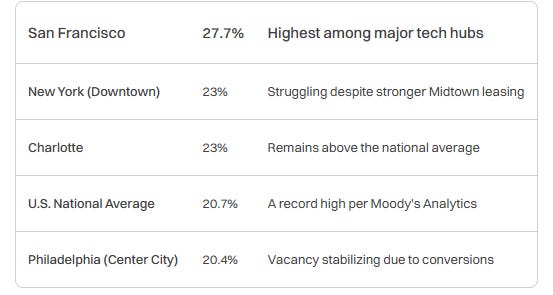
Since the pandemic, there has been nothing less of a great migration of big-to-small corporations outside of highly expensive commercial real estate in big cities. To wit, the commercial vacancy rates in major cities and nationally:
7 stocks (the Magnificent 7) comprise 30% of the US stock market, valued at a total (in terms of market capitalization) $16 trillion, and they are looking rather unhealthy. The collapse of any one of the Mag 7 will spell trouble for the US economy. Of those, NVidia and Tesla are the most hyper-exposed in terms of risk. If there were to be a collapse in demand for NVidia chips (from, say, a foreign competitor, or worse: from a bursting of the AI bubble), then NVidia would be in deep trouble. And for Tesla: Elon Musk is a drug addicted 54 year old whose personality and politics are hurting Tesla sales month after month. If he were to die, or the sales of Tesla truly collapsed beyond recoverability, then Tesla will be in trouble. As for the rest: their overinvestment in AI (especially data centers; read Ed Zitron for more) and the metaverse (again, see Ed Zitron) are going to continually weigh down their balance sheets.
Beyond that though, equity prices are zooming far past the point of comfortability. They are in fact reaching peak valuation not seen since Y2K, which is a key indicator of an existing bubble.
And there’s the 50,000 pound panda in the room: if the People’s Republic of China launches an invasion of Taiwan, that would lead to a shooting war with America most likely, destroying our economy in ways we can’t even imagine. The chips made by TMSC would be the least of our worries.
But wait, people say, didn’t the economy increase by +3.8% in Q2? Yes, and that’s because policy decisions take time to reverberate in the economy. Whatever Trump chose to do in January 2025 started taking effect immediately, true, but it can take months if not years for regular people to feel it in their pocketbooks. Biden’s choices made while he was President contributed far more to economic growth than whatever Trump did.
But voters won't and didn’t give Biden credit for that; it’s all on Trump as he is now President. Such is how public consciousness works. So now the question is: can Trump keep the economy humming at 2% GDP growth or more per month until November 2026?
As shown above, there is much to doubt about the health and state of the US economy. And we haven’t even touched much on Europe’s own issues. Once again, the region is unstable, with the United Kingdom leading the pack of unstable countries. While it is no longer part of the European Union, its fortunes still drive fortunes on the broader continent, and since Brexit, collective fortunes have been driven down. The UK is already in a recession by many indicators. Its decreasing consumer spending as a result will continue the economic spiral of bad times for them, dragging down the larger Eurozone with them as a result. This, combined with higher energy prices from the Ukraine war and trade tensions with America and China, spell potential doom for the European Union. It would only take the election of a Le Pen or the AFD to kill the EU for good, after all.
Trump is in deep trouble, in other words, and that’s before we take into consideration any other of his policies, such as with immigration (less people working means less productivity) or things outside his control such as healthcare (an aging population drives up healthcare costs which does little to actually grow an economy). Democrats could kick up their feet, doing nothing, and still win, in other words. What will matter is who wins, therefore. If a bunch of progressive, lefty Democrats win primaries and therefore the general election, the party as a whole will become far more amenable to leftism come the 2028 primary. If however, a bunch of establishment Democrats win reelection, then the narrative will be that nothing needs to fundamentally change in Democratic policies, and we might as well see a renominated Harris in that case, with all the risk that pick entails.
For those with a partisan interest in seeing their faction take over or retain control of the Democratic Party, we will likely know by the end of the primaries of 2026 what the primary of 2028 will look like. As always: to the victor, the spoils.
Disclaimer: this is not financial advice.