

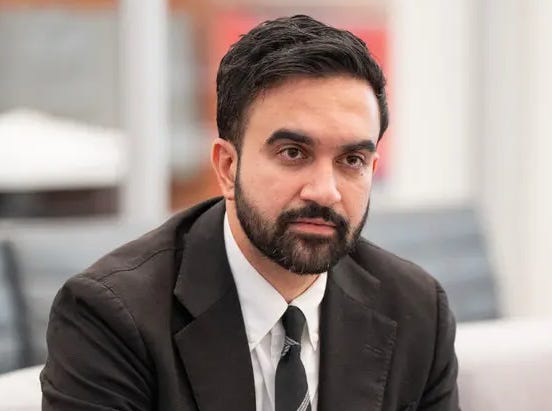
Recently, New York mayoral candidate and Democratic Socialist Zohran Mamdani did an interview where he refused to call Nicolás Maduro and Miguel Díaz-Canel dictators. After a deluge of condemnations and complications, Mamdani clarified as follows: “I want to be clear about my position. I believe both Nicolás Maduro and Miguel Díaz-Canel are dictators. Their administrations have stifled free and fair elections, imprisoned political opponents, and suppressed a free and fair press.”
Mamdani is not incorrect here. Maduro and Díaz-Canel are indeed dictators, by any stretch of the imagination. But when a state is under siege, dictatorship becomes inevitable, even preferable, to any other alternative. And Cuba and Venezuela are beyond a shadow of a doubt, states under siege, even if the technical term under international law does not strictly, per se, apply. Consider the evidence: Cuba has been under crippling US economic sanctions since the 60s, with decades of evidence of covert and overt attempts to overthrow the government. Venezuela has had a shorter period, since 2002, but facing an encirclement no less brutal.
In Cuba, total economic damages could be in the trillions of dollars since the inception of sanctions, once inflation is taken into account. The US economy is also harmed, to the tune of $1.2 billion per year, but as the far larger, more economically diverse country, we take it in stride. Of course, the siege of Cuba isn’t airtight, as many countries still do trade and visit Cuba. Yet, the US constantly and consistently forces other sovereign countries to shy away from doing any trade or deals with Cuba. For instance, in 1991, British Petroleum was dissuaded by the US from investing, and likewise in 1992, Royal Dutch Shell and Clyde Petroleum were also dissuaded from investing. After the fall of the USSR and Cuba’s only major great power ally, Cuba’s economy collapsed yet America’s siege continued. In fact, America’s siege continues even to the present day, despite the whole of the UN (excluding Israel and America) voting to end it.
As for Venezuela, when Hugo Chávez was elected president in 1999, America immediately went to work undermining his democratic election. In 2002, the most overt attempt came in the form of an attempted coup that failed against Chávez, but the failed attempt was only the beginning, with the US beginning economic stranglement shortly thereafter, with increasing pressure and sanctions being enacted against Venezuela. When American real estate gangsters blew up the world economy in 2008, Venezuela was acutely affected, as it relied on petroleum sales for its economic growth. With the recession came a decline in gas prices, which led to a downward spiral in the economy from which Venezuela has been unable to recover from, most especially due to the US and other states cutting Venezuela off from the global market via sanctions.
These states of siege are thus real and affect the material reality of the people who live in those states. If you’re a foreign investor looking to build a new factory in either country, good luck finding a way to invest without using dollars and without touching the US global financial system. And even if you do find a way: those states are rightfully paranoid. Many a foreign investor has come to their shores under false pretenses: sabotaging industries, conducting espionage, assassinating regime officials, corrupting regime officials, and more. There is what can be described as an atmosphere of fear permeating the air in those countries, in other words, which feeds on itself.
