

How does this war end? Before the US-Iran War began, the question could be solved politically, i.e. through negotiated diplomatic settlements. When one side (or both) demands something critical that cannot be met by the other, it either leads to the outbreak of war or one side calling the other’s bluff before people start dying. In this case, no bluff was called, with the United States keeping to its unmeetable pre-war demand of dismantling Iran’s ballistic missile program—an inane, insane buffoonish idea considering that not only would this deprive Iran of their main weapon of self defense (indeed, does Iran not have a right to self defense?), but also of its potential for a future space program. It’s a humiliating, impossible concession for a proud people numbering over 90 million. There was also the issue of nuclear weapons, on which Iran had repeatedly shown willingness to capitulate fully in the name of peace.
Before this war started, Donald Trump retained absolute control of the situation. He could have claimed an easy win by signing a face-saving deal with Iran that spared everything but its nuclear program. Both sides would likely have continued their preexisting animosity, but there would have been peace.
Donald Trump is no longer in control of dictating when this conflict ends. He, of course, determined—by his own executive, unconstitutional fiat—when this war should start, when he decided to cowardly murder Iran’s Head of State. But before he can decide when this war will end, he must decide if he wants it to end. And that, he can decide tomorrow, or right now. For the United States is not operating as a state power right now—as a post-Westphalian entity—but rather as the personal property of Donald Trump, as if this were the demesne of some king during the ancien régimes of Europe.
President Trump has subsumed total control of the American state. And thus, the calculation is far simpler; rather than the state having to be convinced that peace is in its best interest, only one man has to be convinced. Thus far, he remains unconvinced, as he has stated multiple times that this war can go on for “weeks, months, forever.” But can it really?
Brent crude, a key economic benchmark of the oil market, reached $116 a barrel (nearly doubling from its $60 lows within two weeks) within hours of markets opening on Sunday. It's likely shot higher since, with sobering estimates predicting $150 by the end of the week, $200 by the end of the month, and Armageddon thereafter. It's the same story across sectors: aluminum, fertilizer, and so on. If this were just a natural disaster—if a hurricane had supernaturally formed and wreaked havoc on the Middle East—the effects would still constitute the worst spike in global average commodity prices in recorded history. That this can go on “forever,” that this is a war and thus much less predictable than a natural disaster: all of this bodes ill for humanity at large.
When does Trump decide the madness should end? The damage to the world economy is nearly without precedent, to say nothing of the human cost of lives lost on both sides (far more Iranians) and the cost in war materiel (all those fancy radars that Iran is blowing up require expensive rare earth materials that must be sourced from China, another enemy America has made), which is reaching eye-watering numbers. For comparison, 9/11 cost the world economy (just the day itself, not everything that came after, such as the wars) an equivalent of $183.65 billion, or thereabouts. The closure of the Straits of Hormuz costs the global economy $40 billion every single day.
In a week, since February 28, that’s $280 billion, or a little bit over 1.5 9/11s.
In a month, that’s $1.2 trillion or 6.2 9/11s.
In a year, $14.4 trillion or 74.4 9/11s.
And so on.
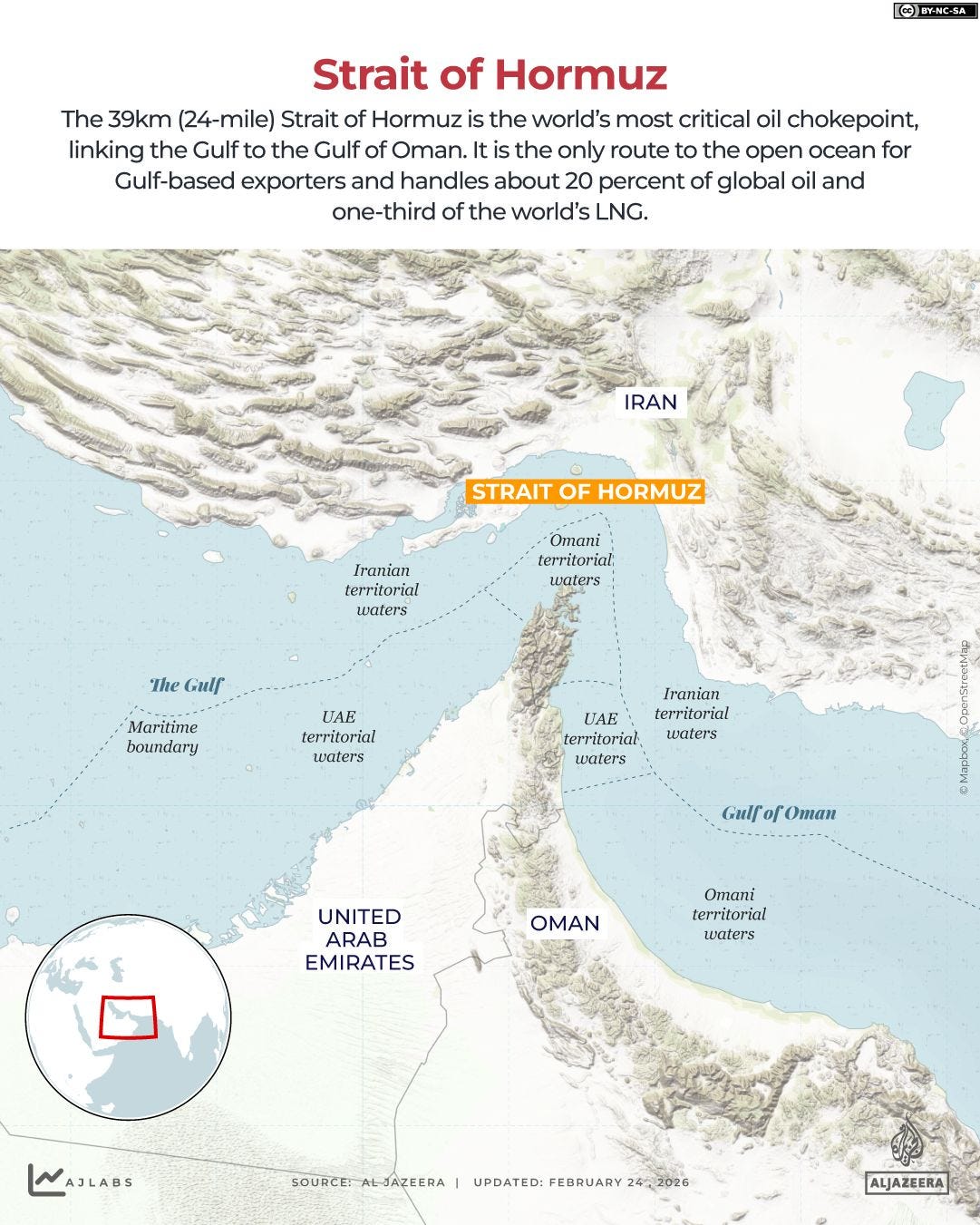
From now until the midterms, assuming this war goes on forever, assuming Iran can keep the straits closed, assuming the United States does not achieve a military victory, then the straits will have been closed for 248 days. That is roughly $9.9 trillion in damages to the world economy. And that’s just the optimistic read.
There were concerns the AI bubble would pop before the war started, and those concerns are about to heighten to a critical level with the price of energy skyrocketing to unseen heights. If the AI sector goes belly-up because of this war, that is it. We can no longer quantify the losses because the sudden removal of the AI tech sector from the world economy—the main thing driving growth in markets—plus Trump’s tariffs, plus the closure of the Strait of Hormuz equals nothing less than catastrophe in socioeconomic terms. Externalities mounting externalities! Famines, plagues, more wars are guaranteed to come from that sudden shock. And if tensions mount to a nuclear level between the powers, that would constitute game over for humanity.
If Donald Trump can decide that this war does not bode well for his political, economic, and personal (staying alive and not atomized in nuclear hellfire) outlooks in life, then the only question is when. It could be tomorrow, or it could be never. Politically, the data is there, plain and present: Donald Trump’s party, continuing on this course, will be routed worse than Liz Truss’s Conservative Party was in the Labour electoral landslide of 2024, and that is being extremely generous to the public in their mounting rage. If Donald Trump cares about having political power, about continuing to be President, he must end this war. The question is, when can he? Only he knows.
But Trump is no longer the only factor in deciding when this war ends. When the United States killed Khamenei, they pulled Iran even closer to the negotiating table, except now the main negotiating is done kinetically, through drone and air strikes. Both sides could win this war through military means, but this war will mostly end with a negotiated settlement. Most wars do, excluding wars of total annihilation and conquest, such as World War II. Even World War I ended with a negotiated settlement, with Allied armies not fully occupying Germany and administering the territories themselves as they would do in the Second World War.
For the US to win this war militarily—to achieve all of its war aims of replacing Iran’s current state apparatus with one pliant to American interests—it would need to fully occupy Iran. The problem (militarily) for America is that it simply does not have the ground forces or the ground force posture to achieve this. For the invasion of Iraq, the United States mustered a force of 300,000. For the invasion of Iran—a country three times the size of Iraq with roughly three times the size of the Iraqi army as well—the United States would need one million men deployed as ground forces. Considering that is the total number of manpower available for call-up if America scraped everything it had, this becomes a daunting impossibility without a draft.
So for the United States to win, it needs to accept an economic cost of about six 9/11s per week, every week, indefinitely, as well as the costs of a draft and the inevitable human costs of the war (How many Americans will die? 100,000? 200,000? More? As Ukrainians and Russians report, modern drone warfare has made war bloody as hell; they’ve lost a million men each according to reports), until victory is finally achieved. Could it be done? If Americans were just automatons that did whatever President Trump commanded them, then yes, America could eke out a military victory like this.
But we’re not automatons, and so the safe bet is that this fever in Trump will break. Eventually. Hopefully. The only other potential for an American victory comes if they can reopen the Straits and destroy Iran’s ability to project power abroad; mainly their missile program. But doing that would likely involve a ground campaign, unless if America’s Anthropic-powered targeting truly is performing unimaginable wonders, and not, say horrors like the murder of over 150 schoolchildren or the Looney Tunes style destruction of vehicles painted on the ground.
As for Iran, it is a full state and thus far more predictable. It is here we can look to Clausewitz and all the other great theorists in history to determine how and when Iran will choose to end this war. This war, for them, will not end on the cognizance of one man, even if that man is the new Supreme Leader. No; it will end when a consensus of the state and the elites who comprise that state agree that it should end, on terms it can accept.
For this case, we must assume Iran will keep Hormuz closed, that its strikes against the GCC will continue, that despite losing missile launchers for every strike, it can still maintain some momentum of daily barrages across the Middle East. It is the bare minimum to be expected of any competent state of its size. A country with that many people, with those many resources, with the amount of mountains it has, should be able to maintain a consistent barrage indefinitely. If it cannot do this, then we must totally reassess its capacity for long-term survival. If, for instance, the United States reopens the straits next week, then this is all moot. The Iranian state would still survive, but its prospects for a strategic victory would become daunting.
If Iran is able to survive and maintain its fire missions ongoing indefinitely, then an Iranian strategic victory becomes possible.
There are, in sum, three distinct possibilities for how this war might end. Which one is achievable, and to what extent, will depend totally on its battlefield performance. This is what Clausewitz meant by war continuing politics: what Iran could not achieve in negotiations, it will achieve on the battlefield. For instance, Iran has demanded that the GCC states expel American bases from their territory. Those states refused. Now, Iran is bombing them daily with drones and missile strikes. If the bases can be eradicated through the bombing campaign, if the economic damages from the strait closure can be sustained, then Iran will have achieved on the battlefield what it could never hope to achieve diplomatically.
The three possibilities therefore:
Strategic Iranian Victory
Strategic American Victory
Status Quo Ante Bellum
The first, a Strategic Iranian Victory, entails exactly what it says: Iran more or less outright wins the war. On the American side, it will mean that Trump has agreed to the fact that he cannot hope to win this war and has begun begging for peace negotiations. Iran will not have to immediately accept, of course. With the US weakened, it will likely keep its attacks flowing daily, removing US military and economic influence by brute, kinetic force. When Iran decides to meet the US and sign a peace, it will be on its rough terms. There might be demands the Iranians have that America would not be able to meet, such as the destruction of Israel or the total expulsion of America from the Gulf (America would likely retain influence on the Red Sea coastal areas of Saudi Arabia and Egypt, for instance). But Bahrain, the UAE, Iraq, Kuwait, Oman: all those entities that launched attacks from their territories into Iran would be made into neutral powers, if not outright aligned with Iran (through revolutions caused by the socioeconomic upheaval of the war, most likely in Bahrain and Iraq).
The second, a Strategic American Victory, entails the United States reopening the Straits of Hormuz and ending the daily missile barrages. With the damage to the global economy localized mainly in Iran, the United States could keep the air bombing campaign until Trump is out of office, at genocidal costs to the Iranians, of course. This, again, can only be done kinetically; Iran will not destroy its missile launchers, and therefore America must, or lose the war. Could it happen? It’s highly unlikely, considering how this war (or three-day special military operation) has gone thus far. But it is the scenario that America would like to see take place. Of course, if this immediate strategic victory is achieved, Trump may very well decide to send in a full ground invasion, all costs be damned. In that case, the outcome again will be determined on the battlefield.
Lastly, a return to the Status Quo Ante Bellum. This won’t happen. Even if Trump begs for mercy tomorrow, Iran will have no reason to stop the war until it can force Trump to agree to its main demands (the removal of US military bases in the Persian Gulf and Iraq). Iran will only throw this demand away if Trump were to threaten nuclear usage, and that’s highly unlikely, even if America were humiliated. And if Trump does threaten nuclear usage, then nuclear weapons will be used, and 99% of humans in the Northern hemisphere will be dead within 5 years as a result.
No one is ending this war until their side is satisfied. For the madman Trump, who knows what will satisfy him? The world economy has already imploded worse than Oceangate’s submersible did. Perhaps nothing can change his mind, perhaps he is a convert to Christian Zionism, and desires nothing else than the building of the Third Temple so that Jesus Christ may return and therefore secure his entrance to Heaven (a key concern for him) despite his sins. Or maybe he’s just waiting for every air defense interceptor to be lost in the attritional war. Who can say for sure, but Trump himself?
As for Iran, the only rational actor at the table, they will continue until every US base is erased kinetically and then for good, diplomatically. Until then, this war will continue, for weeks and weeks until finally, Trump’s mind has been changed, and Iran or the United States have achieved its military objectives.
And Israel? Israel will do whatever the United States of America tells it to, if it would but speak (or be capable of speaking). Unless, of course, if Trump is totally in thrall to the Israeli state. That remains a frightening possibility, considering recent statements.
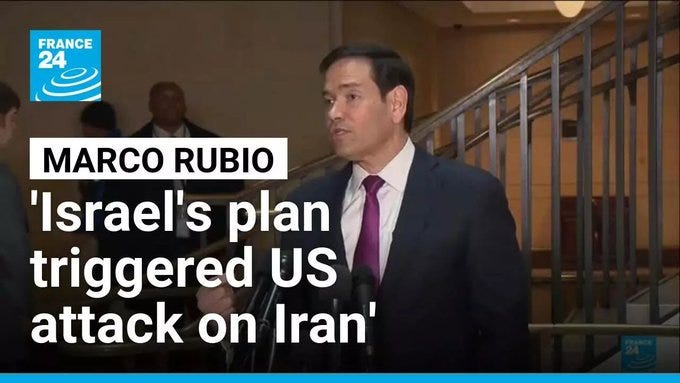
We should pray they are misspeaking, either out of malice or out of stupidity, for the honesty would be too horrid to comprehend.