

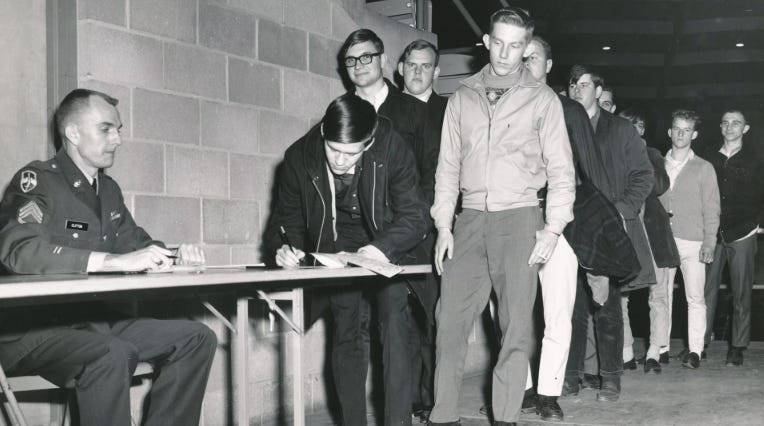
Part 1: The Military Necessity of a Draft
As the Amero-Israeli Axis’ illegal war of aggression against the Iranian state and people escalates, the question on everyone’s lips is: when will the US part of the Axis send in ground troops? As stated previously, the path to a US ground invasion runs through Iraq. Others, smarter than this publication, have already made the conclusive argument (i.e. Harrison Mann) that a naval assault on any part of Iran’s coastline is folly. This means that unless KC-135s keep wanting to get shot down over Iraq, the United States will eventually have to fully occupy and police Iraq (again). And while that could be done with a purely volunteer force as was done in the early Aughts, the same cannot be said for Iran.
For one, Iran is far bigger than Iraq. It’s even far bigger than Vietnam by a factor of five. Iran comprises 1.648 million square kilometers while Vietnam occupies 0.331 million square kilometers. Even being overly optimistic in regard to the number of American casualties, there will be some Americans who will “enter the field of combat vertically and leave horizontally,” to use a common local euphemism to refer to battlefield casualties.
The US presently has, in theory, 1.3 million men and women in uniform it can throw at Iran. But that would mean stripping everyone (even the precious few honor guards at the tombs and cemeteries) from their present duties and sending them to the near-infinite mountain ranges of Iran. Obviously, America would never fully denude its global manpower reserves and commit them all to a mad throw of the dice in Iran, and so that raises the inevitability of a draft.
The US will attrit manpower in Iran. Current casualties (wounded plus killed) are already in the high hundreds, if not thousands. That burn rate, especially considering that ground combat operations have not even commenced, combined with the standard wear and tear humans face (and thus require rotation out of the front), means that the ground forces the US currently has in terms of deployable manpower reserves are rapidly vanishing.
Give it another month, maybe two. Once the United States commits ground forces, the countdown to the announcement of a draft goes from “likely” to “inevitable.” This is, of course, assuming that Trump does not capitulate to Iranian demands, which we can rate as “unlikely,” considering Trump is stuck in a classic (deadly, terrible, Apocalyptic) escalation trap. He could capitulate tomorrow or in ten days or never, leaving it for his successors to handle in the distant future. We simply do not know.
Therefore, the draft. How it will be announced and the societal implications, we leave to better reporters. Sy Hersh, write your heart out (except please don’t actually). Instead, we’d like to walk you through the life of a soon-to-be drafted soldier, from his birth to his truly final, white surprise. It’s a work of fiction, to be sure, yet one grounded in the reality of this war and in the basic realities of warfare as well as US doctrines and procedures.
Part 2: The Life and Times of Sergeant John McCandy Burger
January 20, 2009
Your name is John McCandy Burger. You were born1 in Columbus, Ohio on January 20, 2009 to two doting millennial parents both born in 1991. Like past fated draftees such as in the Vietnam War, you grew up poor, with working-class parents (indeed, they came of age just as the Great Recession hit!), and definitely without any financial or political connections to spare you from the frontlines. You’ve already survived a lot, having lived through the dual fatal epochs of school shootings and the Coronavirus pandemic of the modern era.

January 20, 2025
As you turn 17 and enter your final year of high school, Donald J. Trump is taking his second oath of office. Trump has been present your whole life. Your first conscious memories, in 2013, were of your father reading Trump’s tweets about Robert Pattinson. You’ve supported him some days, you’ve hated him others. Mostly, you haven’t really cared, as you can’t vote and even if you could, you know your vote wouldn’t really count or matter in much of anything. All you knew was that things were good during Trump’s first term (Coronavirus and the mass shootings excluded) and things seemed to be going from worse to terrible under Biden (his old age and all the wars). If you felt hope at all, it was that things would go back to normal (as normal as America could ever get), with no war and a middling poor, yet ultimately satisfying existence to look forward to through the rest of your days.
June 13, 2025
Meanwhile, in the background of your life, Trump bombs Iran on June 13, 2025, kicking off a “12 Day War,” or so it is called on the various apps you use. If you notice it at all, it is gone just as quick as it came, so you continue to not pay attention. You graduate and start working at your father’s boutique X (formerly known as Twitter) Post (formerly known as Tweets) Shoppe for basic minimum wage but mostly tips.
January 20, 2026
In January, Trump kidnaps Nicolás Maduro. The Ukraine war is still raging. You celebrate your 18th birthday with your friends and your girlfriends (yes, you, like many others, are polyamorous, to the dismay of your quasi-religious parents, who are both, unbeknownst to you, non-ethically non-monogamous).
February 28, 2026
A few weeks go by. Trump bombs Iran again for the second time. It sounds more serious than the last time.
June 1, 2027
For the next few months, the news you get goes from bad to worse, and then to the very worst case for you: the Army draft, long thought dead, is suddenly brought back to life, first in rumors and wild speculation, but eventually in codified, enforced mandates. Before you know it, you, son, are being sent to the front! You can’t even muster a sarcastic hip-hip-huzzah as your draft papers come in. There’s no deferment for you; you didn’t have enough money or good enough grades to go to college, so it is off to the 11th Infantry Battalion of the 249th Armored Tank “Husky” Division of the United States Army.
Or, that is your final destination. First, though, you must go through the various steps of becoming a soldier.
It is on June 1, 2027, that you receive your draft and induction orders. You are given at most ten days to prepare, marry, have kids, buy a new Dodge Ford Ram at 34.5% APR, or whatever have you, and then it is goodbye to civilian life, perhaps for good.
During this time, you report to a local Military Entrance Processing Station (MEPS), which swears you in, screens you medically, issues your uniform, and then gives you your first orders. Congratulations, son! You’re in the Army now.
From there, it’s off to training. For our purposes, let’s say you go to Fort Moore, Georgia (infantry One Station Unit Training site). You’ll be taken there by either commercial bus or air, and likely under Army escort.
June 11, 2027
From June 11 until October 25, 2027 (or thereabouts, a total 18 weeks), you will attend and graduate from Infantry One Station Unit Training (OSUT).
In your first week, you go through the classic initial processing things you may have seen in film: haircuts, gear issue, and distillation of Army values. You learn how to make your bed the way the Army likes it, how to tie your shoes the way the Army needs it, and even how to defecate like a proper Army grunt.
It’s your second week, June 18, that things begin in earnest. They’ll start you with Combined Basic Combat Training. Once you get through that, it’s Advanced Individual Training, complete with Red/White/Blue phases for marksmanship, tactics, land navigation, physical fitness, vehicle ops, and small-unit drills. In 18 weeks (or sooner), you’ve graduated as a certified infantryman with MOS 11B. Typically, outside of wartime, infantry is given an extra four weeks for a total of 22, but wartime constraints already allow it to be shortened to 18. If manpower demands are critical, training could theoretically be shortened further.
November 1, 2027
Assuming 18 weeks of training, that’ll get you to November 1, 2027, by which time you’ll have joined the rest of the 249th Armored Tank “Husky” Division. From here, it is another seven months of collective training, until May 31, 2028. As this Division does not really exist, we can place it on a base where it can be deployed to the Middle East with ease, which means a base such as Fort Bliss, Texas.
You’ll be assigned to a line company in a brigade (let’s just say 1st Brigade). There, you’ll learn how to wage true modern war; the last training set just taught you how to be an infantryman—this is the real deal. Here, you’ll learn squad and platoon live-fire, partake in company-battalion field exercises, brigade-level maneuvers, digital systems training, and get acquainted with modern division gear: Abrams, Bradleys, HIMARS, and crucially, drones. They’ll also put you through your paces with a focus on desert/mountain warfare and rapid deployment drills. Finally, by the end of May 2028, your Division is certified “deployment-ready” after a major capstone exercise.
June 1, 2028
For the next month, you’re just waiting for the order to go. You get your deployment orders and handle your final affairs (for real this time; you are leaving the United States), which means things like medical/dental, wills, family briefings, equipment packing, and so on. All the while, your Division is already moving heavy equipment, likely to the Port of Beaumont, Texas.
July 10, 2028
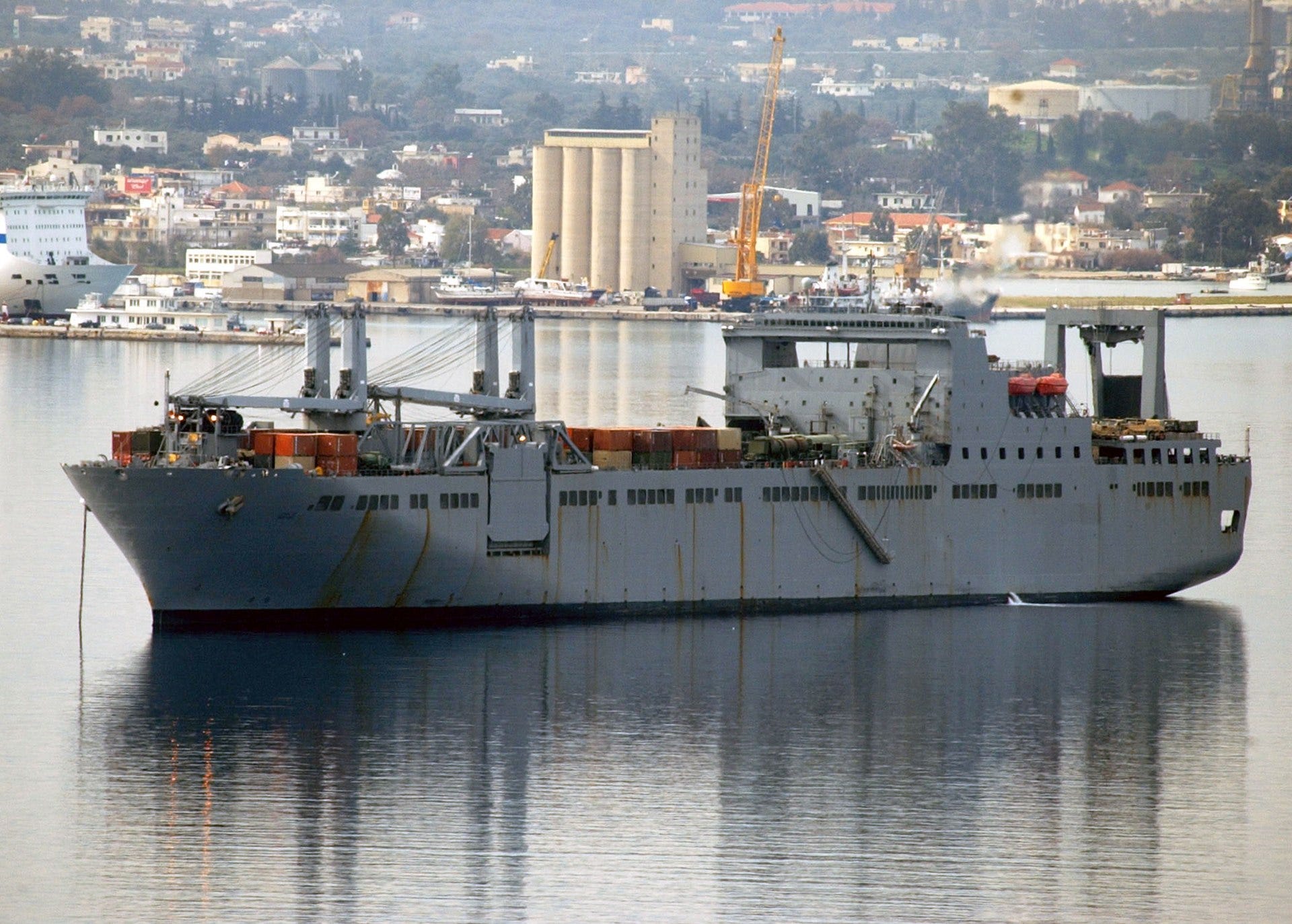
You do nothing save what the Army tells you. Mostly, this will be spent doing drills and paperwork. You get promoted to Sergeant; due to a shortage of NCOs and the US Army adopting, since the start of the Iran War, IDF practices in many cases (including overpromotions as well as illegal double-tap strikes on civilians or surrendered enemy combatants), this is not uncommon for newly minted soldiers. No first-class voyage for the heavy equipment, alas. That boards an LMSR Fast Sealift (or similar ship) and begins its long journey to the front. That trip takes a total of thirty days at an agonizing 24 knots. It leaves Port of Beaumont with part of the Division on July 17, 2028. The equipment ultimately transits from the Atlantic through the Gibraltar Strait, then the Mediterranean Sea, finally terminating in Haifa, Israel. While other rendezvous points could be used, this assumes the continued closure of the Hormuz Strait and the Red Sea indefinitely, and Turkey’s and Egypt’s (professed) continued neutrality in the conflict. It’s only in mid-August that all the heavy equipment arrives in Israel, and it is from then that you make your final way to Israel.
August 15, 2028
You’ll board a commercial or military charter plane and either spend some time in Ramstein, Germany, or fly direct to Ben Gurion, or a military airfield near Haifa. That is assuming Israel still has usable airports by this point; if they don’t, you are boarding the slow, 24-knot boats above. Full off-boarding, staging, prepping for movement, and so on takes the rest of the month.
September 1, 2028
You start moving, with the rest of the Division, overland from Israel through Jordan and into Iraq over the course of 10 days. You depart Haifa on September 1 and take the Israeli highways east to the Allenby/King Hussein Bridge on the Jordanian border in tactical formation, which, when paced for security and maintenance, averages 150–200 miles per day for a large armored column.
On September 2, you transit for the next four days overland through secured highways in Jordan with Jordanian escorts.
Then, you cross the Iraqi border on September 6 near Ruwayshid and are moved to your final forward assembly area inside Iraq.
By September 15, the rest of the Division has set up on the front lines in Iraq, with full division combat effectiveness assumed by the end of the month.
Your Sad, Sad Future
You don’t know how you die. It just happens one day, though there have been plenty of close calls. Who was winning the war when the final cut to black hit? It didn’t matter, not to you. You just had a job to do, and you did it. It didn’t matter which village you razed or what town the enemy recaptured. Your life was mundanity and sporadic dreadful excitement until the sudden end.
Before you die, you conduct patrols, fire support, and provide forward presence. There are drones everywhere, and constant missile barrages from deep within Iran, unreachable by US forces. You suffer in makeshift concrete bunkers, crawling forward and backward in offensive and defensive actions in movements more akin to World War I than any other modern war.
Then it’s over, and you die.
Or maybe you don’t. Maybe the FPV drone (bought on Temu for $11.99) that was meant to kill you kills your buddy instead. You survive that encounter and therefore your entire first rotation. You return home, spend whatever time with whomever you want, and then it’s back to the front. For the US Army can, for the duration of the war, keep you in the Army, serving in active duty, until you are either dead or until it is done, and the United States has either achieved final victory or final defeat.
Months, decades, years go by.
They make many sad movies about men like you. “The Second Lost Generation,” the kids these days call you. Assuming you avoided death in service, the day you die is January 19, 2056, one day before your 47th birthday. The war goes on, or it has been lost already. Your cause of death is noted as a statistic in the memorials: “toxic environmental pollution from the Iran War,” a nice way to put “exposed to an ungodly amount of carcinogenic chemicals and bodily stress” during the war.
Two hundred years after you die, one of your great-descendants plays a simulation of your service. They consider you a loser, and that you should have gone home, G.I.
Maybe you should, G.I.
While you still can.
Weight: 7.5 pounds, Height: 19.5 inches