


At some point in the future, Kharg Island will be attacked by US forces. If you want to know how that operation will play out, look up the Snake Island campaign in Ukraine—except multiply everything by a factor of twenty (Kharg Island is twenty times the size of Snake Island). In short, it’ll be an incredibly bloody mess for both attacker and defender, and its seizure by any party won’t “end” the war, much like Ukraine’s final “victory” (if you can call planting a flag on a deserted island a victory, deserted due to incessant Russian drone strikes) on Snake Island.
Therefore, let’s continue focusing on the bigger picture.
In my last article, I covered the military inevitability of a US ground invasion of Iran via the northern Azeri corridor. Nothing has changed since then, and I stand by everything I wrote 100%. However, I should have been clearer: this is the military strategy I would recommend if I were in the US military. From a purely military standpoint, it’s the only logical option with a chance of victory—a two-pronged ground invasion from the North and South, with both prongs meeting somewhere in central Iran. Of course, this is politically and economically infeasible, even insane to suggest.
The manpower requirements alone (up to 4 million ground personnel on the US side, with a final total commitment in the double-digit millions) would demand World War-level unity in the US—something Trump assuredly lacks, especially in blue and purple states. It would require activating the draft, which alone could break America apart. To say nothing of the economic cost: without massive tax increases, the Crash of Hormuz plus the Tariff Wars would trigger a stagflationary spiral, even before the first new Army division forms.And then what? The US would be committed for at least ten years, invading and slowly “pacifying” Iran square kilometer by square kilometer, mountain pass by mountain pass—much as Russia is slowly gobbling up Ukraine. Like Russia, the US has a competent general staff that games out strategies nonstop and makes recommendations to political and economic decision-makers. Their top recommendation, ignoring political and economic feasibility, is a two-pronged ground invasion via Iraq and Azerbaijan, with early emphasis on Azerbaijan due to its proximity to Iran’s political and population core, the Tehran metropolis, which houses 10 million people.
But that’s not a choice Trump can make. He doesn’t want to, even if it’s technically the only way the military can win—as he knows he lacks the political support for total war (though that’s effectively what his demands for peace amount to: total war against the Iranian state and its people). If the Hormuz Straits were out of the equation, Trump would declare victory today and end US involvement, leaving Israel to fend off the Iranians—just as he left them to handle the Houthi-led (preferred journalistic style: Ansar Allah) Yemeni armed forces.
But Trump can’t do that either. If he could, he would. But he can’t. Iran has closed the Straits. That doesn’t just mean losing 20-30% of the world’s daily petroleum and natural gas output—though that alone would be apocalyptic. It’s everything else: fertilizer shortages, banking collapses, real estate crashes, helium shortages (think: no more semiconductors, phones, or advanced electronics for anyone but states and militaries due to exorbitant prices), the AI bubble—it’s all interconnected, all collapsing in real time.
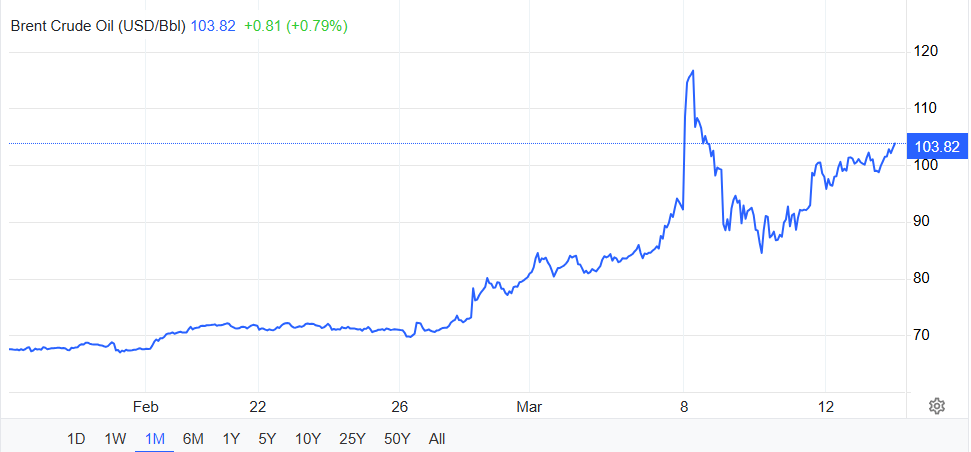
The markets gave Trump 12 days to wage his war, expecting it to end like the aptly named 12-Day War. We can see this in Brent crude prices. On March 8th, panic gripped the market, prompting the US Treasury to stabilize it. But that blatant manipulation couldn’t override the reality that the Straits remain closed, with no reopening in sight. So, the price of Brent—initially propped up by hopium and Treasury intervention—broke past $100 a barrel on March 11th and has stayed there since.
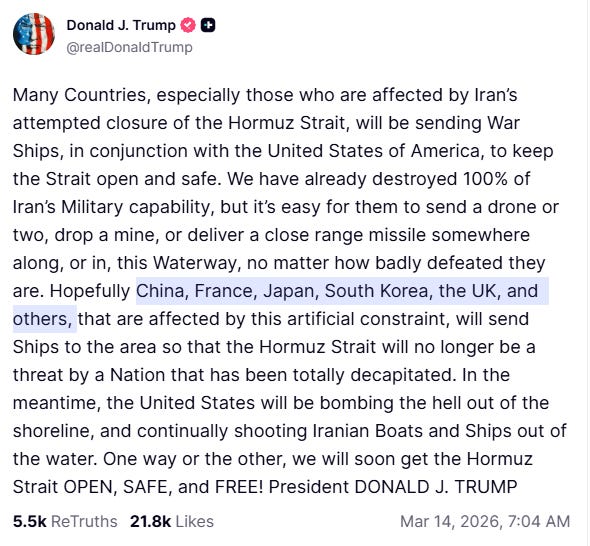
Therefore, Trump needs the Straits reopened for all the obvious political and economic reasons. As such, today on March 14th, he called on several countries to join him in an operation to reopen them.
It’s impossible to reopen the Straits without a ground invasion, and impossible for that invasion to succeed without massive manpower. It would probably take more than just 5000 marines! By comparison, the US invasion of Iraq required about 600,000 personnel total. Assuming similar manpower pools (more on that shortly), the ground campaign against Iran might play out as follows. I stress I’m just an amateur journalist, historian, and military enthusiast. This isn’t based on insider info—just my own analysis. But if the US general staff had to recommend a strategy excluding a draft or Azeri front (Turkey has barred its Azeri vassal from joining), this would be the next logical option.
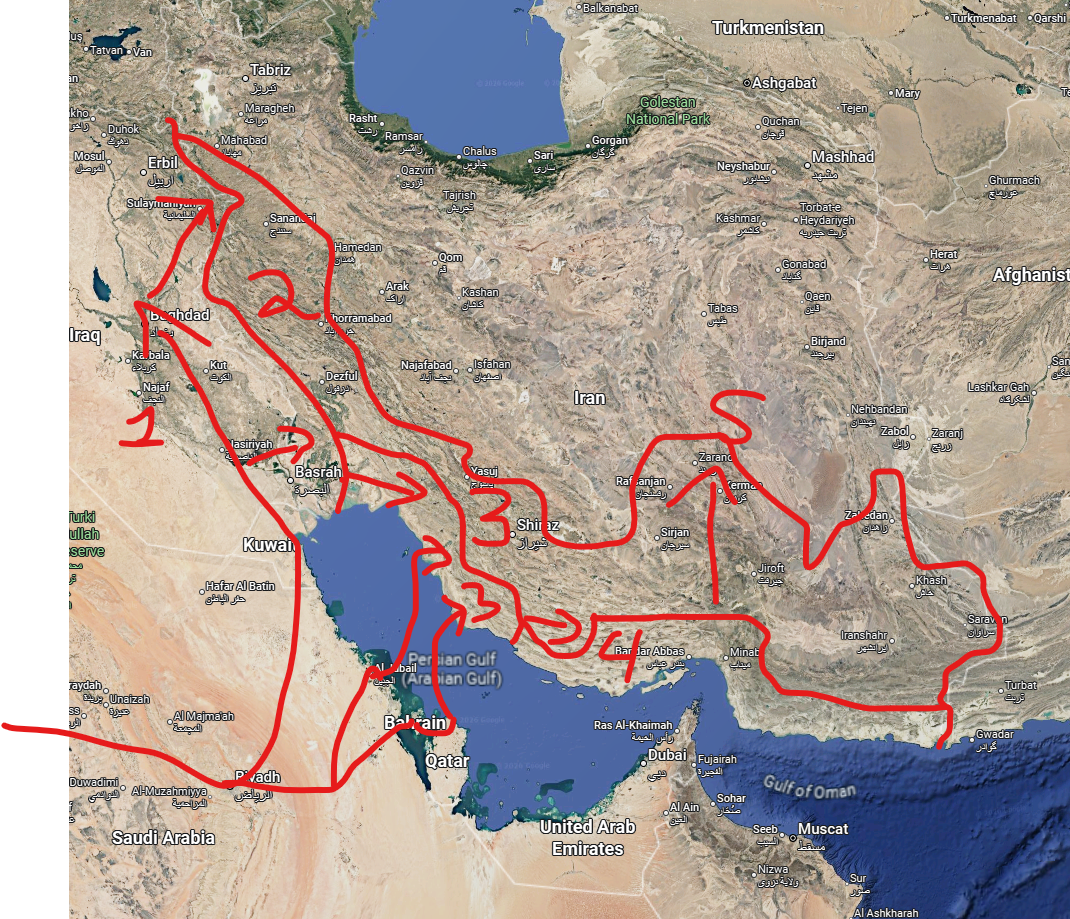
The first objective: secure the Iraqi front, tackling Resistance-aligned forces—perhaps even toppling the Iraqi government and installing a US governorate to disarm the population, including of course the Popular Mobilization Forces.
The second objective: secure and hold the Iraq-Iran border. At least half of all US-aligned ground forces would hold here (and on garrison duties) across Iraq, pinning down a significant chunk of Iranian troops on the Iraqi front.

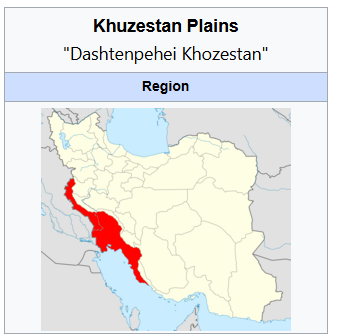
The third objective: a mass armored and aerial incursion into Khuzestan province, one of the few spots where US armored doctrine can shine. With air supremacy and armored spearheads, the US could seize this area with relatively few casualties.
The fourth objective is where things get tricky. The US and allies would snake along the coast through mountain ranges and deserts, covering hundreds or thousands of square kilometers. Here, the invasion would bog down, with guerrilla warfare crippling US supply lines and manpower. A draft would become urgently necessary.
We’ve entered pipe-dream territory. For the fifth objective, remaining US forces would advance on a broad front, securing countless mountain ranges, passes, and valleys. Without draft-level reserves, this could lead to catastrophic defeat (think Napoleon or Hitler in Russia: total annihilation of US ground forces).
That said, the US could accomplish objectives 1-3 with current troops, especially if allies like South Korea and France contribute ~100,000 men each. As for US manpower alone: the Army, Marines, Reserves, and National Guard total slightly over 1.1 million ground personnel. Most are stateside or awaiting call-up; the US could deploy 500,000-750,000 to the Middle East.
I say “easily” only in terms of not imperiling national security by removing them from the 50 states—the answer is yes, as 100,000 could suffice at home. But logistically, it’s tough: the US would need to seize merchant marines for transport, offload in distant Red Sea or Mediterranean ports, then trek to Saudi jump-off points—all while enduring brutal Iranian drone and missile strikes.
Building up for phase 1 (objective 1) would take 6-9 months. Meanwhile, Hormuz stays closed; in fact, US midterms would be underway or over. Assuming Trump doesn’t care about Congress, this may be his only choice. His only other choices (arbitrarily numbered with reasons why he cannot in parentheticals) are impossible to consider:
Nuclear strikes until Iranian capitulation (risks imminent, perhaps inevitable global thermonuclear war)
Humiliating US regional withdrawal and negotiated peace settlement (it’s not an option Donald Trump can pick, let’s be for real)
Mass US ground invasion of the North and South (with what political support?)
Therefore, this option, once the Kharg Campaign is underway (or maybe it has already started) will become the only feasible one left. Except this will still end in humiliating US failure. Let me show how the future will likely unfold:
March - November 2026: the US amasses a ground force in neighboring friendly countries to tackle Iran and its regional allies, mainly in neighboring Iraq. At the same time, US and allies sustain heavy casualties via Iranian drone bombings, and are forced to abandon their bases closest to Iran to conserve manpower and heavy, irreplaceable equipment.
November 2026 - January 2027: the US ground invasion of Iraq begins and ends. US casualties are low during the initial phase, but spike as forces transition to garrison duty.
January 2027 - March 2027: the US launches a joint naval invasion across the Persian Gulf and across Khuzestan province. Any attempts to seize more land are met with stiff, unyielding resistance.
March 2027 - ???: the US seizes the rest of Iran’s southern coastline.
However: if the US is able to accomplish this goal, then Iran will still be able to keep the Straits closed. None of it will matter, as Iran will still be in drone and missile range of the Straits. So, the US will force itself deeper and deeper into Iran, and it will always be “one more mountain range” until victory. This would drag on for years, draining America’s political and economic strength. Iraq and Iran become ulcers on US manpower, with Trump promising wins just over the horizon. If Russia’s war against Ukraine ends in Russian victory, it will be because the attritional math of grinding manpower and equipment ultimately worked out in their favor (Russia just has more people than Ukraine, simple as). Same will it be for America and Iran, assuming American leadership is as unchanging as Russian leadership.
But at some point, Trump will no longer be President. At some point, simple biological facts about human senescence will become true for Donald Trump as it becomes true for all humans. Will a President Vance, or a President Someone Else continue Donald Trump’s war? I personally choose to doubt it, and there is reason to believe that a President Someone Else (or even Vance) will see the writing on the wall and blame Trump for the failed war and thereby seek a negotiated peace.
Trump, of course, can’t. He must win; defeat isn’t an option while doubling down remains possible. And it is: as Commander in Chief, he can order deployments to Saudi Arabia and invade Iraq. It’s entirely plausible! Absent other choices, this will be his next move.
It’s only a matter of time.