

Our understanding of the world is best understood in the lived experience context of the last one hundred or so years; for us, this is World War One (both its lead up to and aftermath). To understand why the world’s alliances and antagonisms are the way they are, that is where we must go to. And, in analyzing that, we can begin to grasp certain truths about human nature and the nature of states and how they both reason together.
It was Germany’s imperial ambitions to seek maximal benefit for themselves, or more accurately, Kaiser Wilhelm’s and his ministers’ bumbling idiocies, that led to what scholars called his Weltpolitik1; in other words, his state’s aggressive foreign policy. That aggressive Weltpolitik led directly to the Weltkrieg, a world war, and the reactions all states took to that conflagration has informed the actions of both states and individuals ever since.
World politics must be understood through a materialist perspective, but also heightened with the additional scientific knowledge of human psychology and sociology, and all the other sciences Marx could not even dream of. An understanding of our world cannot only be a story of class conflict, or a story or individuals or even groups of individuals. It must be a story of all of them, from the smallest, youngest person to all living and soon-dead 8.3 billion persons, all moving every day, every hour, every second, 365.25 days a year, across nearly a tenth of this planet’s surface. Seeing the whole megastructure from that distance should be a moment of awesome respect; when you see it for yourself, do not merely bow: prostrate yourself before the maw of humanity. For only then will you begin to understand how the mechanications work, and how they can begin to be changed.
Ein unicycle
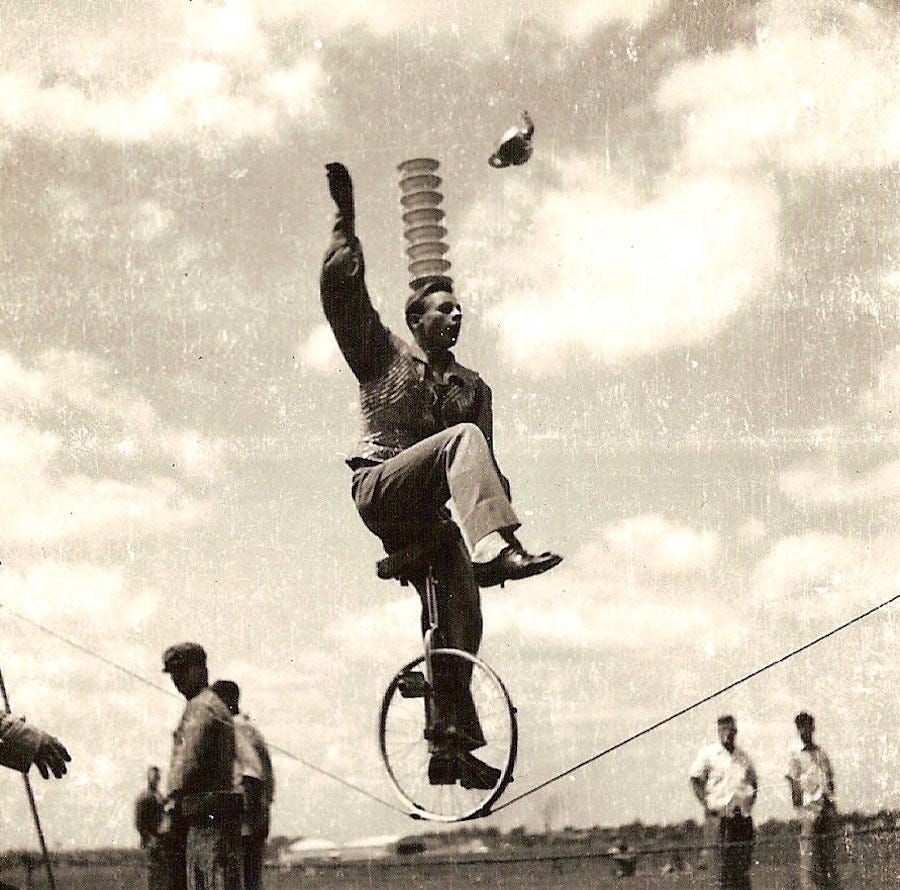
Imagine a performer, on a unicycle, spinning plates from two sticks he is holding aloft, on either hand. His wobbles and shakes, his fight against gravity, the imperfect clumsiness of his tools, and the general anxiety that comes with any performance make the next moment utterly unpredictable. Will he crash? Will he burn? It is unknowable to you, the observer, and mostly to the performer as well. In a performance, the only universe that matters is your own: your own moves, your own steps, everything choreographed and trained beforehand to comfortable precision. But it is all practiced guesswork; the right move rightly performed may still, from a gust of wind or violent spectator, lead to catastrophe.
Thus it is with world politics and world wars. Atop our unicycles of imperfection, we spin our plates, planning and executing our next moves. Then, other players enter, from every side of the stage. If they move in synchronicity with the original performer, then their efforts can combine into new positive displays. But if they move erratically; if one goes left and the other goes right, then no system of exchange can occur. The whole performance falls apart.
Language forms the basis of this mutual communication, but as with the performing unicycle players, it need not be verbal. In world politics, it can be a diplomatic signal, a signal often so inane in definition that some form of soothsayer is needed to understand it. Other times, it is plain and spoken, even written: of treaties signed, and trades concluded.
Truthful communication over time builds trust, as anyone who has ever loved or performed on stage will know. You trust that your partner will react predictably—for that is the true object of desire in human nature, predictability—and if they do not, that action decreases trust, such that future interactions will forever be tainted by that foul one. In the tango of unicycle performances, continually rushing into other performers is a surefire way to be expelled from the stage, a surefire way to never be invited to perform again. Conversely, reacting predictably (and well), will lead to plaudits not just from observers but from fellow performers.
And so, a predictable dance brings predictable fruits and rewards. Those whom you successfully partnered with in the past you will want to partner with again. Thus is born good trade relationships, and even alliances. Why does the United States government support NATO, support Taiwan, support Israel oh so much? It’s not because of corrupt bargains or some deeper conspiracy (though, rest assured, individual bad actors abound in any society) but rather because in that insane unicycle dance of nations, no one wants to be the first to stop, or to even suggest a change to the rhythm.
You don’t want to be the performer who crashes the performance, even if the immediate cost is low, because over time, your fellow performers become your friends. You trust each other. You do more than just unicycle balancing—you also golf, babysit each other’s kids, exchange letters. So it is with alliances and trade: what starts as an exchange of letters can often end up in mutual defense and aid pacts. While this is an admirable quality, it runs into two sets of issues: what if your friend picks a fight with another group you are not close to? What if you yourself do?
For no society, no government, is led by immortal plate-spinners. The current generation dies and retires, handing already-spinning and teetering plates to the next generation. Most of the time, they can barely stop the whole thing from toppling over, and thus that restricts them in what they can achieve or even imagine.
Ostpolitik - Ostkrieg
Why did the United States not invite the Russian Federation and Ukraine into the NATO alliance post 1991 or even post 2001? Why didn’t the EU even dream of integrating Russia, their largest energy provider? Had Yeltsin (and the elites that backed him) been invited to the table, integrated into the NATO order, it’s likely that Russia today would not be invading Ukraine. Of course Russia has territorial claims over Ukraine; Germany has the same with France vis-a-vis the Alsace, yet we do not expect a German invasion of France within our lifetimes! Had Russia been in NATO as Germany is in NATO, there would be no war!
The reason why is quite simple: the leaders of America in the 90s and 2000s were not neutral arbiters with a perfect grasp of world history. They were biased makers of their own world, their decisions informed primarily from the end of World War 1 when Lenin’s Russian government signed a peace treaty with the Kaiser’s German government, greatly strengthening the Central Powers just as they were beginning the Spring Offensive of 1918. While this may seem like ancient history to us in the present, to those in the past, there was no greater stab in the back to the Entente.
We know the war ended in a minor Entente victory (minor for they did not occupy all of Germany and dismantle its state) for us but to actually live in Spring 1918, when the first Americans were just beginning to arrive yet not in enough strength to truly change the outcome of the upcoming battles, when all of Germany’s power could be focused on the West: there was real fear that Germany would be able to use freed up divisions and the resources from newly conquered Ukraine to smash through mainland France, conquering it entirely, as they did indeed would do in 1940.
The Entente powers immediately set about denouncing newly communist Russia, and all their governments and all their governments’ agents and all those aligned with the same-said policies (the business elite and the bourgeois voter) set about an unholy crusade to induce another revolution in Russia (thus ousting Lenin’s government), and force it back into the first World War.
When the war ended with an Entente victory anyways, Western animosity still remained. Even though Germany had been laid low, Entente forces occupied parts of Russia well into the 1920s. In the 1930s, they and mainly former Central Powers such as Germany and Japan conducted acts of sabotage and espionage against the growing Soviet Union. When, in 1933, the United States recognized and began trading with the Soviet Union, they did so mostly out of economic desperation due to the Great Depression. This form of acquiescence was also the reason for the invention of the Allied Powers; to defeat a worse enemy (Germany), the Western powers aligned themselves briefly with the Soviets.
But after 1945, and Germany was truly defeated for a generation or two, the impetus for the West-Soviet alliance died immediately. It’s important to note that from the Soviet perspective, the alliance need not have died. As their subsequent actions showed after the German-Soviet peace was signed in 1918 and after 1945, they weren’t really enemies of the Entente powers, instead so much so as so thoroughly and utterly beaten by Germany that they needed a generation to rebuild and recoup their losses. There was indeed a great fear from the Entente that the Bolsheviks would either ally with the Kaiser or collapse even further (thus letting all of Russia be open for Central Powers dominion); either way, their act of peace with the Kaiser showed that they could not be trusted.
And so, we became enemies, waging a new Weltkrieg albeit a cold one against the Soviet Union. For the West, the issue was predictability. The Soviets under Lenin fundamentally betrayed the West’s trust, and even though their government did everything including bend over backwards, it was never enough for a rapacious and violently anti-communist West. While the socialist ideology did preach animosity towards capitalist states, practically immediately after the German Revolution failed in 1918/1919, the Soviet Union did immediately try to mend relations with the West.
The West, as it turned out, never bit on Russia’s or the Soviet Union’s overtures. The breaking of trust between states could not be forgotten by the individuals who ran American foreign policy, even after fighting together through the muck of WW2, an animosity which was inherited by the next generation during the Cold War. By 1991, Western animosity towards the Soviets still raged on, all of it sourced back to Lenin’s original sin.
Exeunt Pax, Exeunt Deus
Where then does that leave us? In the modern era, America and the rest of the West remain firstly aligned with each other due to the shared living memory2. Thus we count amongst our friends the British and the French (Entente alliance, 1917), and our enemies the Russians (1917) and the Chinese (1949, Communist victory over Nationalist China). Just as humans seek predictability, so do states. And unfortunately for humanity, just as they seek predictability, so too do their systems of mutual animosity (e.g. states) towards one another.
It would be fine if mutual love and respect, that Great Commandment of yore, the kind of respect you saw between NATO allies pre-9/11, was the rule of the world. But because the plates did not start spinning at the same time, because the people spinning those plates were imperfect, because natural disasters forced plates to collapse without warning, thus did we see a world-state without peace. For as Uruk stood against Elam, and as Pharaoh stood against the Hittites and Greeks3, so too will the American President against the Russian and Chinese Presidents. An outside observer with no knowledge of world history or humanity will still, knowing this fact, be able to predict that there is existing inter-state animosity somewhere on Earth, so long as humans exist.
But does this need to be the case? In viewing the whole stage, performers to the left spinning their plates in opposition to the performers on the right spinning their own plates, the whole thing looks rather silly, does it not? Forget the complexity of unicycle spinning plates: just consider any board game with two players or two teams. In real life, with friends, whenever an issue arises from playing the game, people can just stand up, and either choose to not play, or to come up with their own rules. Either way, when the game is finished, all friendships can (and should!) resume.
Here’s the truth: there is no grand scoremaster keeping score. Building the most number of tanks, the most guns, the most nukes, the most anything will not grant any reward other than that which the thing can do. If there were a supreme scoremaster, they would witness the shuffling players, angrily staring at each other, committing their entire national wealths into new and gaudy ways of massacring the other’s populations, and declare stop. Not only is the game not fun anymore, but people are getting hurt.
Of course, the Western powers have grievances against Russia and China and all their other enemies. Those countries have their own grievances, too. But the Western powers also have internal grievances, which they mostly paper over due to their relative minority in offence against the sheer weight of the precedence of the alliance (indeed: only had the US attacked Greenland or Canada would NATO have collapsed). It is that compassion, that understanding, that feeling that even when your friends act untowards to you, that you trust them (and can thus predict their next motions) that brings you back together.
All world powers should recognize each other’s grievances and accept them. Forgiveness is not only a religious imperative for many but also a psychological fact.4 Once that is achieved, then may the powers meet in accord and harmony5. For the stopping and the great rearranging of the plates (as it were) means to stop Weltpolitik and to end the state of Weltkrieg for good, and for when the Weltpolitik resumes, for it only to resume in a Pax Humana.
Wilhelm’s foreign secretary: “in one word: We wish to throw no one into the shade, but we also demand our own place in the sun”, in opposition to British hegemony.
A traveller from an ancient land once told me that living memory lasts only as long as back to your grandfather’s grandfather’s lifetime; or, 100 to 150 years. Meaning, any event that happened 100-150 years ago is likely within the common knowledge, and part of the lived experience of people. Not that people cannot remember things that happened before then, only that those things tend to fade into myth and legend, or more accurately in the modern era: stuck in hard to understand dull and dry scholastic books found in the bellies of underfunded archives.
You must alas study more history circa 3000 BCE to 500 BCE. You will conclude many things, but one thing you will see constantly is that we never really had a chance for world peace, until now.
I read a study once which said in essence: “those who are forgiven gain nothing relevant to the forgiver; those who forgive are blessed with calmness in clarity and heightened emotional intelligence.”
For instance, Russia should today say, “We understand that our leaving the fight during World War 1 hurt the war effort in defeating the Central Powers. We recognize the pain that was caused to the Entente, to its soldiers in the field, to its civilian populations at home. We regret that our Tsarist and then later governments could not withstand the might of the Central Powers, and that we, the present and future generations, deeply regret that we did not aid in the defeat of the Central Powers.” America should say, “We understand the woes that befell you during the first World War, woes we ourselves were only spared by the sole grace of our oceans. We deeply regret the harm and occupation inflicted upon your people by the German Kaiser and his allies. We also apologize for our mistake in occupying your country and in treating you like a hostile state, and all the resultant pain that caused. Your ancestors deserved better treatment than they got from our ancestors, and we apologize.” Once both sides begin to speak and deal honestly with one another, that is how both sides can build trust, can restore predictability, and, with nothing else but “God willing”, we can have global peace!